
‘I Don’t Make Mistakes, I Make Compost’. Paul West and Darryl Nichols on how growing food is good for you and the planet.
👂 Listen on Apple Podcasts
👂 Listen on Spotify
👉 Why listen?
Growing your own food is awesome 🥦🍓🫑.
It's good for you, good for community and good for the planet 🌏. So why isn't everyone doing it?
Turns out many of us think don't have the space, don't know how, or don't want that awful feeling of 'I tried, it died'.
Paul West, Darryl Nichols and Andrew Valder have a good idea.
They make it easy to begin by sending heirloom seeds to your door that, when you flip the pack, have a QR code on the back that you can scan to have the who's who of Aussie gardeners to show you how to grow. And there's more.
Through webinars, 'ask me anythings', real world events, workathons and a good ole' fashioned 'best produce' awards with a twist, they're making growing food something everyone can get involved in and all us to benefit from, whether it's from bringing more pollinators into our cities or simply eating healthier food.
In this episode you will hear:
😊 Why growing food is so good for you
🌏 Why it's good for community and our home planet too
Why people get involved, and why they don't
🌶️ How things like wonky vegetable awards bring new fun to one of the world's most skills
🍅 What's growing on in TV legend Paul West's garden
🍓 Just how many strawberries, cashews and pretzels Paul and Darryl can eat in an hour (it's a lot) 🍓🍓🍓🍓🍓🍓🍓🍓🍓🍓🍓🍓🍓🍓
Tune in now or see Grow it Local for yourself at www.growitlocal.com
The Story in Brief
Imagine picking dinner from a patch you tended, still warm from the sun, and knowing that simple act just cut waste, saved carbon, and strengthened your connection to where you live. That’s the promise we explore with Grow It Local co-founders Paul West and Daryl Nichols, who are helping Australians learn to grow, cook, and share food with confidence and joy.
We start with why: growing food isn't just about yield. It’s a way to get out of the built environment and back into the natural world, even if it’s a pot of basil on a balcony. Paul explains how that hands-in-the-soil habit boosts mental health and rebuilds agency over what we eat. From there we tackle the real barriers—lost know-how, time, and space—and show how knowledge sits at the top of the tree. With the right guidance, anyone can start, anywhere.
Then we get practical. Grow It Local’s model pairs live workshops and member Q&As with seasonal heirloom seed deliveries. Each packet’s QR code opens short, friendly videos on varieties, growing steps, and patch-to-plate ideas. It’s low-tech on purpose: learn online, grow offline. We share hard numbers too—members compost more, divert kilos of food waste each week, eat fresher produce, and plant for pollinators and water care. Councils partner to fund access, stream workshops in libraries, and co-design hyperlocal activations that make learning social.
Culture keeps it sticky. From the colourful Grow It Local Awards to ambassadors across music, surf, and kitchen culture, we celebrate gardeners of every stripe and the wonky veggies that make us smile. We also open the playbook on funding differently—working with local government and turning members into co-owners through equity crowdfunding—to build a values-led, impact-first platform.
Ready to turn curiosity into tomatoes and compost into carbon savings? Hit play, then join us at growitlocal.com. If this conversation sparks an idea or a seed, share it with a friend, subscribe, and leave a review so more people find their way back.
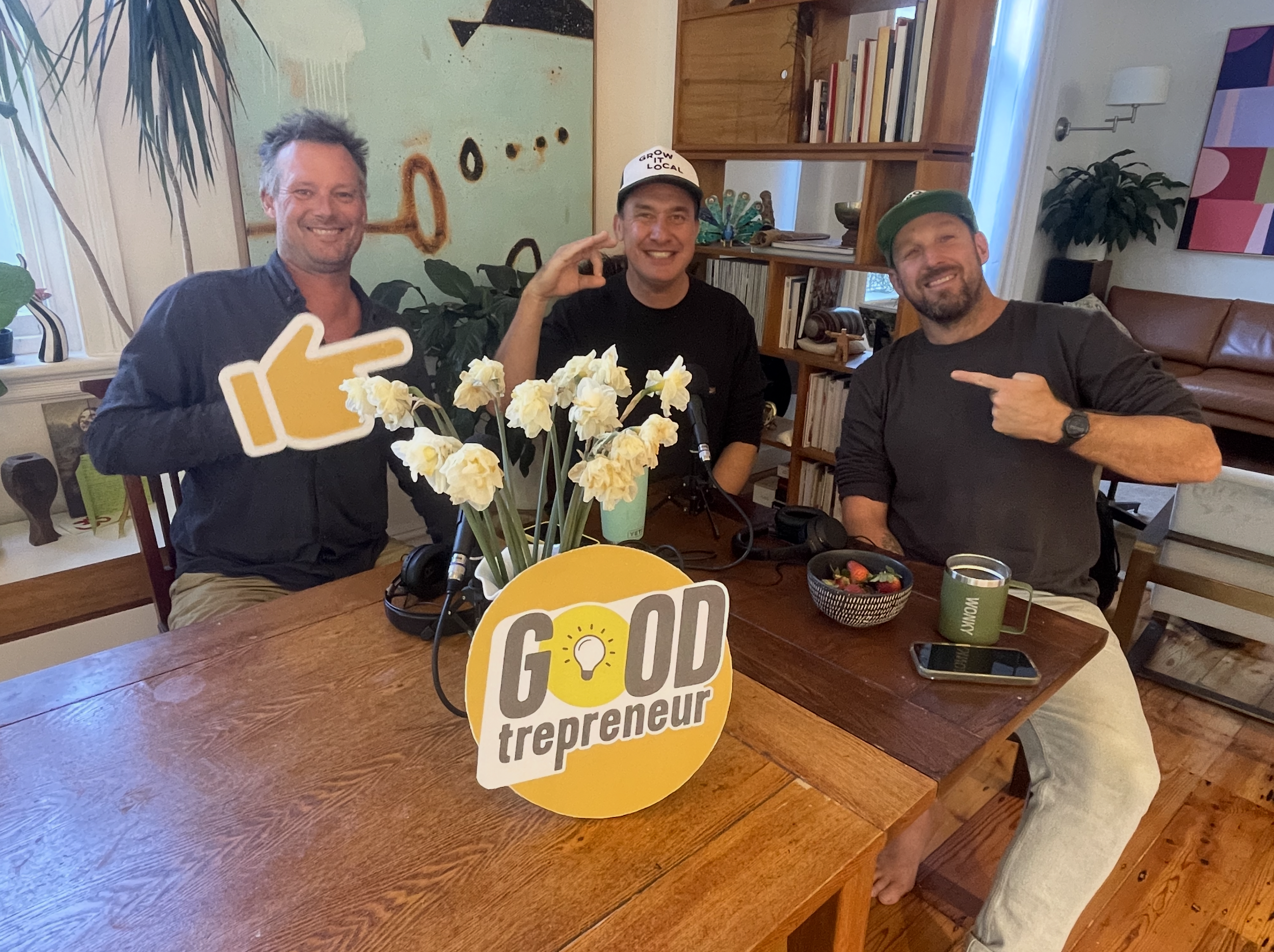
Recording in Sydney’s Bondi Beach, with Paul up from Bermagui for a few days
Full Episode Transcript
Ben: 0:15
Food. It's one of the most wonderful things in the world. As a wise person once said, it's our common ground. What we grow, how we grow it, and who we eat it with helps define our relationship with ourselves, our community, and the planet itself. So when we change how we do food, we change the world. It's no wonder so many people want to get their hands in the dirt. In fact, one in two Australians already does or wants to learn how. And that's what today's good idea is all about. Grow it local makes it easy, fun, and social to learn to grow your own food, then cook it into something delicious. It brings together some of Australia's best-known gardeners to give you all the tips, tricks, workshops, and heirloom seeds you need to get growing. And with over 40,000 people involved, it seems to be working. Here to tell us all about it are co-founders Daryl Nichols and Paul West. G'day, fellas. Hello, Benny. Geda. So, Paul, you're a master of food in the garden. Why is it so good to grow your own food?
Paul: 1:13
Well, I mean, that's a pretty big kind of question and very multifaceted, but I think one of the most important reasons for growing your own food is it's a way of physically connecting to the world around you and more importantly to the natural world. We spend so much time in the built environment as human beings, you know, in our own homes, in our places of work, in our cars, uh, and in structured and human-built environments that we don't get to spend as much time as we have historically or ancestrally in immersed in the natural world. And you know, if you go to a national park, you know, you kind of stick to the trails, leave only footprints, take only photos, that kind of thing. But it's when we get in our gardens that we're actually literally putting our hands into the earth and connecting with the natural world in that way. And then on the flip down the track from that is that the efforts and labors that you put in from that interaction with the natural world, you actually then bring them into your own body. And, you know, you literally are what you eat, right? Like it's, you know, that term gets used a lot, but there's a literal sense to it as well, in that, you know, if you're tending this amazing patch of ground, the vegetables are doing all these complex chemical interactions with sunshine, soil, and water, and then they embody all of that. And then we eat that, and then we embody that. So I think that eating from your own garden is a way of embodying the place where you live and where you are.
Ben: 2:36
And I guess as I said, yeah, physical health and mental health. And as I said in the intro, there's the planetary health value as well, too, right?
Paul: 2:42
Without a doubt. You know, it's it's a fundamental part of being alive is eating. And by taking your own role within that, there's a degree of agency in in choosing what you get to eat and having that ability to say, well, I don't want to eat something that's grown in a way that degrades the environment, or I don't want to eat something in a way that's grown with synthetic chemicals. I want the food that I ate to be grown with sunshine, compost, and water.
Ben: 3:07
Is that do you find because you talk to a lot of people, right? Both of you talk to a lot of people about this, obviously. Is that what's the one that really gets them isn't in? Is it like, oh, it's great for my mental health getting out? I just enjoy it, makes me relaxed. Is it no, I want to eat healthier now? If I grew it, it's not got chemicals on it. Or is it, no, I feel that you know I'm adding to nature in the planet and I'm doing something sort of better for the world? What's the start?
Darryl: 3:29
I think it's all of that, um, Benny, all wrapped up into one almost sort of magical green bullet growing food. It's sort of like Paul said, it's one of the oldest pastimes known to humankind. We've been, you know, cultivating food since the earliest ages. And when you grow food, um, there's so many benefits that you get as an individual for your country that you live on, and of course, uh for your community too. What we've found over the last uh sort of five years of um since launching Groat Local in this incarnation is that when people grow food, they develop a greater appreciation for food, which leads to essentially less food waste. The other thing that happens that's absolutely fundamental when you start growing is you soon or very quickly realize that the soil's the engine room of your garden. And the best way to improve your soil is to, of course, get yourself a compost or a worm farm, which is helping divert food waste from landfill and building, uh putting that organic matter back into the soil to help you grow more nutrient-dense food into the future to share with your family, friends, and loved ones.
Paul: 4:31
And I think that people come to it for a whole lot of different reasons. You know, it could be, it might be someone finding solace of mental health, it might be someone that wants to, you know, grow vegetables to feed their kids, or maybe they don't, they just want to grow organic food. But I think that the universal appeal is that interaction with the natural world that I spoke about before. And I don't think that I think we're all in a bit of a nature deficit in modern society. Uh, and it's really hard to squeeze it into your the hustle and bustle, especially, you know, family life, you've got kids, you've got school drop-offs, you've got work, you got career, you got all that. So packing up and going camping up the coast for two weeks isn't easy. But you can still have that vision of the in the natural world and that that interaction with it just in a pot of herbs on your back doorstep. And people like, oh, really? Like this, that's not very nature, is it? But if you go and watch that and see it grow and change through the season and see pollinators coming to visit us at flowers, like it's it's all connected. So it does, it's not about having like the biggest, best, most productive garden. It's just about having some garden.
Darryl: 5:31
And I don't think, you know, I personally have never been out in my patch and come inside and said to my wife or kids, I'm so stressed. I'm really won't be doing that again. I'm wigging out.
Ben: 5:42
Um yeah, one of the things you notice is almost whole like Instagrams dedicated to my new leaf on my plant. And people celebrate that one new leaf. You're right, it does it. It's um it's almost mindfulness, it's connection, like you said, but there's a mindfulness to it, is that you just don't notice this happening around you. It happens on every plant that's everywhere, but you don't see it until it's the plant you tend and suddenly you're so aware of it.
Darryl: 6:02
And it's actually like it's magic. You can take a seed, you can plant the seed, and it will grow a plant. And if it's say, let's say it's a tomato plant, it'll go on to give you, you know, in the vicinity of 20 kilograms of tomatoes that are most the most delicious, nutrient-dense tomatoes you've ever eaten in your life. And it just came from one seed.
Paul: 6:21
Yeah. And and it is magic though, right? Like it's we kind of know that's the process, but then even if you try to understand it from like a scientific or chemical point of view, like it that doesn't do it justice. Like it's converting sunshine, it's converting the output of some giant ball of gas in outer space, and then taking that and forming it into carbohydrate, and then sucking stuff out of rocks in the ground, like it's and turning into the incredible edible thing that we get to enjoy.
Darryl: 6:51
It's the best. And when you get to cook with that produce that you grew yourself, there's honestly there's nothing better, there's nothing more delicious. Like you can go to the local farmers' markets, you can go to the local co-op, but when you actually grow it and you pick it and your food miles are less than 10 meters to your kitchen, that's a wrap.
Paul: 7:08
Yeah, and it's not to say that like homegrown food is always better, because it's sometimes it doesn't work out, right? Like in some people that grow tomatoes or whatever for the supermarkets, like they're professional farmers, they're good at growing food. But I think where it really cannot compare ever is one if you get it right, it's 10 head and shoulders better. But where no matter if you stuff it up or you nail it, is that personal connection to it. That like, it's all right that it's wonky, it's all right that it might not be perfectly straight, it might like have a couple of funny little dots going on there, it might not look like the perfect tomato. But the fact that you took it from seed or seedling, tended it, loved it, fed it, watched it, harvested it, then cooked it and prepared it for your family. Like it's nourishing not just on the physical level, but also on that psychological and spiritual level. I made that as well.
Ben: 7:56
It's literally the feeling of I made that, right? Yeah. So, I mean, as you said, we could go for an hour on this. We're doing a pretty good job so far. But um, if it's so good, why aren't more people doing it?
Paul: 8:07
Uh, because it's not easy, I think. Like so many good things, the things that we know are good for us, you know, like just eat your seven serves of fruit and vegetables a day and make sure you get your five times 45 minute light aerobic exercise, and make sure you're strength training, make sure you're saving money and you make, you know, there's so many things to do that we all know are right, uh, but can be hard. And I think again, it goes back to, you know, people lead such busy lives that convenience trumps again, right? Because we think, well, why would I go spend that hour or a couple hours a week, depending how deep into the hobby you are, maybe it might be 20 hours a week, to create stuff that I can just go and pick up for, you know, spare change from the supermarket. Not anymore. Not anymore. But yeah, but and we've seen that happen over the recent yeah, definitely since the pandemic, and with all the flooding that happened in southwest New South Wales, flooding that happened in the northern rivers, the bushfires. We've seen that that scarcity of food all of a sudden takes away that illusion of convenience and cheapness. Uh, and we're exposed as not having you know food systems in place. We're totally dependent on that centralized, sorry, food system to be able to feed us. So I think it's probably multifaceted why people don't engage with it themselves. And I and I imagine a big one is because we've lost that connection through the generations. We just don't know how we just yeah, you just grew up like your previous generations, you grew up on the farm or you grew up wherever you grew up, and your grandparents were there, your parents were there, everyone's growing food, you were expected to participate in it, you know, to for survival. Because if you don't, sorry, no iPad, you gotta farm the potatoes there, kid. And as a result, you learnt how to grow food through those natural rhythms of the season. But because we've lost that, now that a lot of that knowledge to the to the average punter has been lost, but I think the thirst for the connection hasn't been. I think the knowledge has been lost, but I think the deep, innate desire for that connection to be growing your own food in some way is still there, and people don't know where they plug into it. Because it's like it's it's magic. And once you know the basics, it works. But if you've just never done it before, you try once, you know, something germinates, you lose interest, it wilts, it dies, you're like, ah, that was too hard. Whereas if you nail it and you're supported in learning how to do it from the beginning, then it's the opposite. You kind of get more and more enthusiastic, more and more excited. And next thing you know, you're gardening tragic.
Darryl: 10:28
And perhaps you know, we hear a lot from the members that join us at Grow It Local, they're just they're spending so much time on these screens in front of the laptop, on the phone, on the iPad, on the multiple screens at work. And in many ways, it's I think this idea of growing food, it's about logging off and slowing down. And it it's probably accelerating the level of interest and engagement in this really simple old school pursuit of like tickle the worms, get your hands in the soil and grow something. And it's certainly the we were involved in a a study with the great people at the Australia Institute that was released end of last year called Growing Food to Feel Better, Eat Better, and Help the Planet. And what came out of that was essentially 45% of Australians report that they're growing something at home, whether that's um, as Paul says, in a pot, on a balcony, on a windowsill, in your backyard, on a verge, in your community garden. But of the remaining 55%, about two-thirds, so roughly 7 million Australian households, um, say that report that they're interested in learning how to grow. And when you sort of unpack, when they went into unpack, well, what are the barriers? There are three key barriers. They are a perceived lack of knowledge and skills, uh, a perceived lack of time, and a perceived lack of space. And so with Grow At Local, it's about trying to sort of help people overcome those hurdles and learn that you know you can do this regardless of no matter how much space you have.
Paul: 11:48
Yeah, and knowledge sits at the top of that hierarchy, I reckon. Like the time and space part with the right amount of knowledge, you can overcome those two hurdles as well. So I think that's and that's where we kind of have seen the opportunity to step in and address that shortage to give people accessibility to the knowledge of learning how to grow.
Darryl: 12:06
And think about like any of the say, you know, growing food and gardening is one of the top 10 sort of activities, I guess, or pursuits or hobbies here in Australia. And if you think about some of the others, like I don't know, playing rugby, swimming, um, even fishing. Fishing. Um, you know, if you when you learn to swim, you don't just sort of get taken out into the middle of the pool or offshore and thrown off the back of a boat or into the pool and you can swim. You have a teacher or an instructor or a coach that teaches you how to do it. But when it comes to growing food, it's always very much been trial and error. And so there's been no real structured learning pathways for people. We all love watching Gardening Australia on a Friday night, and you know, we get so much out of our different education channels online. But yeah, with Grow at Local, we just try and give people sort of a structured pathway through which they can have their hand held, learn to grow, and also celebrate failure. You know, it's pretty normal. Everyone does it.
Paul: 12:57
Exactly. I remember seeing this a guy at a gardening festival because they're the kind of festivals I go to now. Uh rages, all nighters, um, whereas a guy going, I don't make mistakes, I make compost. It's like uh just food for the next one, right? Exactly. It doesn't, it's every every person that's been growing for any amount of time has killed more plants than you'll ever even think about sowing, you know. You just turn those plants into new plants, right? The cycle just keeps going, it's great. There's there's no mistakes. That's the one of the great things about it.
Ben: 13:24
So tell me that you said before, it's uh fundamentally about making it easier for people to do it. Yeah, giving them that know-how. That's the top of the needs tree, if you like. So walk me through it. How's it work? Where do I begin? I go to a website and I do what? How does this pretend I know nothing and take me on the journey?
Paul: 13:42
Right. Well, young Ben, you might be sitting at home on the couch one day, scrolling through Instagram, just having a look there, and you see uh, you know, you see maybe a message come up on Instagram going, Do you want heirloom seeds delivered to your place? And that uh that triggers something deep in your mind going, Yes, I do, and I do want to grow food and I want to learn how you click on the ad and you go through and you land on the grow up local website, right? So if you're just a first-time visitor, um there's stacks there of like blog content, how-to articles, exploring, you know, some of the fundamentals around starting seeds, around building compost, building soil, building raised beds, all the kind of 101 stuff, exploring a few plant varieties, some of our workshop content. But then if you want to go deeper, you can sign up as a member. So we've got two tiers of membership, two basic tiers of membership. One is free where you actually have to sign up and you allocate what climate zone you're in. Then you can register for one of our monthly workshops. So they're one of the real drivers of education within the business, where we every month we run a live digital workshop where we get some of Australia's most inspiring gardeners, people like Costa, Hannah Maloney, Sophie Thompson, uh, as well as, you know, kind of emerging educators and communicators through from the social media kind of world. And defined self, I believe. Yeah, every now and then. So that's a real key education driver. And I mean, as a free member, you can sign up for one of those to kind of get a taste for it. And then if you want to go a little bit deeper again, you've got the subscription product, which is unlimited access to sign up for the 12 workshops that we run through the year. Also, as a free member, sorry, just backtracking for a sec, I run like a kind of monthly digital hangout where people can just come. It's kind of like gardening talk back, but in the Zoom era. So we just turn it on for an hour. Any free member can come along, they can bring their questions and it's kind of speed dating garden problems. Because what I think what we're really conscious of wanting to do is that like gardening is such a earthy, you know, natural world pursuit that we don't want it to become digital. We're not trying to go, oh, don't worry, like here's this one-stop machine where you just press a button and it spits food out in three months. But what we want to do is use that community building and that education sharing ability of technology to be able to skill people up, to be able to, you know, interact with the platform, learn something new, and then go and implement it in their own garden and have access to the quality of education that they might not have otherwise in their community. So then if you want to go deeper again, you've got the f the paid product, which is a subscription where people have unlimited access to the monthly workshops, the member Q ⁇ A's, the full back catalogue of workshops, and they also get a seasonal delivery of heirlim seeds. And they also have access to uh an ask an expert service, which is like an email-based question, which we'll get back to them in 24 hours. But there's something pretty amazing about the seed packets as well. Daz, do you want to talk about you know what? They're not just they're not just regular seed packets.
Darryl: 16:40
No, they're not, Paul. But no, you're right. The seasonal selections of heirloom seeds, which are curated by Paul, have uh just essentially a big QR code on the back of the pack. You scan that code and it will take you to content that includes it involves people like Paul and Costa and Connie Cow and Mel Lagozo that will essentially teach you about each of the varieties you're about to learn to grow. Um, so those how to grow videos cover the background to the plants, the health and nutritional benefits of the plants, uh, tricks and tips to go from having a seed in your hand to um something delicious you can harvest, and in many um instances also sort of um patched different ideas relating to patch-to-plate approaches for how you might sort of turn that into something delicious.
Ben: 17:21
I mean, I find this genius. You know, it reminds me of um wheels on luggage. You know, when I first saw wheels on luggage, I'm like, why did this take 50 years for somebody to figure out? And it's the same, right? I mean, literally, you get your seed packet, you flip it over, you stick your phone in it, and there's a video of someone showing you how to grow the things. I mean, to me, that's just the most beautiful innovation because it doesn't use any amazing technology, right? You shoot a video and you stick up a QR code. Yeah. And it's those little simplicity things that really make this thing fly, in my opinion. The other one that you've just mentioned, which I love, I always thought, you know, that one of the great challenges of gardening is it's this most creative experience, right? It's almost the unmost most creative. Like if you do a painting, you stick on your wall and everyone comes into your house and goes, what a great painting, and you get refreshed with you know, you know, sunshine back on you over and over again. Whereas in the garden, you grow something, you cut it down, you eat it, and it's gone. And sometimes no one ever sees it. It's like this solo creation experience. Yeah, but like I wonder to what extent do you think that other innovation, if you like, of creating, giving people a digital community for what can be a solo pursuit is really important.
Paul: 18:31
Well, I think you've really hit the nail on the head there about gardening being super creative, but also being something that we tend to do in isolation. Uh, you might have a gardening family or you might be a member of a community garden or some sort of gardening group, but I don't think it's a stretch to say that 99% of gardeners, it's something they do outside by themselves, no matter where they are, if it's on a balcony or in a backyard or a verge or whatever their patch is. But I think there's there's two kind of strings to that bow of this being a part of a community. One is that yes, like like your tribe attracts your tribe type thing. So there is this space where, especially with things like the member QA, where people come and they ask questions and they might think it's a stupid question, but then there's no such thing, obviously. And then the chat kicks off with people going, Oh, the same thing happened to me, and oh, or I tried this and that happened to me last year, and then I did this. And so people feel like supported in their mistakes as well. Like it's not just there's not this expectation to be like, especially when you're consuming like content on social media, right? Like where everyone puts their best foot forward. It's like, oh, look at this. It's everyone's got the Chelsea Garden Show in their backyard, or they've got some incredible, they've got the agrarian kitchen market garden.
Darryl: 19:38
And they're really good looking. They're really good looking.
Paul: 19:40
How do you wear that white linen in the garden? Like, how does that even work? It's amazing. Where are all these kids come from? So there's that kind of shared beginnerness, I think, as well, when you join the community and everyone's like, oh, actually, like it's cool. We're all here making mistakes, and that's fine. And and it's a really encouraging and supporting community, which is one of the things I love about gardening, right? It's such a the community in general, whether it's online or in real life, is just the most supportive, enthusiastic, down-to-earth, creative group of human beings. I always like to think of gardening as a massive dickhead filter. There's not really like a, you know, if someone's like, yeah, I'll grow a few veggies, like, oh right, you're a dickhead then. Um there's not really a lot of that. It's like a bit of a personality litmus test, I think. But I think so there's that, there's I I did mention there were two strands to that community element. One is that that you kind of feel supported in being a beginner or making mistakes, and you know there's other people around you like that. But I think the other thing is that, and this is something that I think Grow At Local does a really amazing job of. Um, Daz mentioned the partnership with the Australia Institute earlier, is that the yearly impact report that we do is a way of not just going, well, gardening, everyone knows gardening's amazing, right? It's good for mental health, it's good for your body, it's good for the environment. But when you actually start to look at the collective impact of people growing food in their backyards, then those numbers start to get some shape around them and some hard data around them. And you actually go, oh man, like home food growers, home food growers are actually having a really positive impact on the earth, on their own health, on the health of their communities and of just the environment more broadly. I'm sure you've got some stats if that might spring to mind there, Daz.
Darryl: 21:21
Just a couple of little spicy numbers. Absolutely, Paul. Thanks for the ballpark. The Grow a Local Report is something we've been working on for about four years now. And every year we seek to try and I guess understand our collective impact in terms of how do we quantify and qualify all the good stuff that's being achieved through the work that's happening in on in backyards, on balconies, in community gardens, and on windowsills across the country. And each year it just blows our mind. So we've found that it's about two-thirds of everyone who starts growing food adopts composting. The average household who starts composting is diverting about 2.3 kilograms of food waste from landfill each week. Currently, with the member base, I think it's around 44,000 uh members across the nation, representing about 1.7 million square meters under cultivation, building biodiversity, building soil, uh, connecting people to nature. But within that community, each week, there's about 58,000 kilograms of food and organic waste that's being diverted through the members' home composting activities. And that represents about 117,000 kilos of carbon that's saved from being emitted into the atmosphere through that process of the composting process. So it really is a case of small actions, big change, I think. Yeah, we've also found that people who start growing food develop a significantly greater interest in eating healthy, fresh, seasonal, fresh fruit and vegetables and consuming it's up to about eight times that of the average Australian. So, in terms of the health and well-being um sort of implications, that's a bit of a um absolute winner. We find that once people start growing food, they develop an interest in growing natives more broadly. They develop an interest in pollinators, and that sort of further down the track leads to an interest in helping to build or create environments for local wildlife. And in fact, that they have a significantly more sort of uh considerate impact on water conservation. So they're much more conscious of water usage. And the benefits just go on and on and on. It's uh quite remarkable. In terms of celebrating sort of gardening as a creative pursuit, um, at Grow at Local, we've tried to, I guess, uh bring together evidence-driven data that supports why you might consider getting into this activity, not just for your own well-being or benefit, but for that of your country you live on and for the planet too. But to couple that up with a whole lot of fun and making it sort of really social and engaging. One of the things that we put together and run every year is called the Grote Local Awards. And unlike most sort of, I guess, traditional gardening awards, it's not a pursuit for the most beautiful landscaped lawn or manicured garden. It's a search for the wonkiest vegetable, Australia's best chicken name, the homegrown harvest award, local grower of the year award poll. And every year we just see the most incredibly colourful and just inspiring submissions that come through the hashtag local awards from what's the best chicken name?
Ben: 24:15
Um I can't wait any longer.
Darryl: 24:16
Best chicken names of the last couple of years. I think we've had Dame Egner, Hen Stefani, Hen Stefani, and then we had a runner-up, Princess Leia.
Ben: 24:25
How's that the runner-up?
Darryl: 24:27
But you know, it just puts a smile on your face, and then you're seeing these carrots that look like all manner of things, um, often lots of genitalia. But just at their heart, really fun and makes you smile. And that's another great entry point into this activity is sort of making it feel inclusive and accessible.
Ben: 24:45
Isn't that funny? Because in if you see that wonky vegetable in the supermarket, everyone everyone walks a mile. When you grow it, you stick it on Instagram. Yeah.
Paul: 24:52
Yeah. So bringing the fun into it really is a huge part of it. And just like giving people license for it not to be perfect. Like so much of what you see, as I mentioned earlier, is curated, or it's, you know, by some crazy garden designer, someone spent a hundred thousand million bucks on, you know, designing the perfect garden. But the thing that I really love about growing and gardening is that every garden is a unique expression of you and your place. And, you know, there's no two gardens that are the same. And every gardener's garden or every person's patch is a unique extension of who they are and where they are.
Ben: 25:25
So it's fun, it's creative. So have you have you got a lot of stats you gave us, but have you ever looked? Is this together Australia's biggest farm?
Paul: 25:33
Well, it would be. I mean, what do we say about honey? No, not in Australia.
Ben: 25:36
Well, let's skip the cattle ranches and just go for farms that grow food.
Paul: 25:39
Yeah, it would have been close for sure. Definitely for vegetable production, it would be up there for irrigated annual vegetable production. Like, so if you took out cattle farms and you took out wheat farms and, you know, all that dry land crop. It'd be up there. But while the thing that gets me about that though, is that we often talk about, you know, these big managed landscapes like big cattle properties where they might be a million hectares or whatever, but there might be 20 people working that. So the human density per square meter of tending to that property is really minute. But it's when you get into the garden, the backyard garden, that it's I'd say it's the most densely peopled managed landscape. Because you've got, you know, you've got big farms, you've got crown land, you've got smaller farms, but it's not until we get into our own little mosaic of backyard gardens that the human density really comes in. And as a result, you get all this diversity that's an extension of the individuals who do it.
Darryl: 26:31
And the impacts already at this scale, whilst not huge, it's certainly sort of we're making progress at 40, you know, odd, 44,000 odd members across the country. But Paul, you know, the vision is much greater than that. Like, what happens when you get hundreds of thousands, millions, tens of millions?
Ben: 26:47
And you don't have to stop in Australia, obviously. Yeah. So I want to go back to the start because you go, this is clearly a good idea. You have the idea. Hey, what if? Like, look, it turns out everybody's sitting there not knowing how to do it alone, or failing alone, or feeling like failures and don't want to talk about it. And suddenly, what do I do in my life? I do what I enjoy. What do I enjoy? What I'm good at. So, how do we get them good at it? And you come up with the idea. Where do you go from there? You're both sitting together, what, enjoying a carrot together or something, and you come up with this idea. What do you do to kick off an idea?
Paul: 27:19
I was a bit late to the party, actually. Uh it got pitched to me at the um Sydney Tomato Festival at the Royal Botanic Gardens where I'd just done a tomato growing work. Yeah, so good. It worked. I've just had a delicious lunch, um, you know, right on the little bay there. That's probably one that's best for you to answer, Daz.
Darryl: 27:37
Yeah, sure. Well, originally Grow It Local happened some time ago. We, my sort of OG partner in crime, Andrew Valder, we'd set up the garage sale trail that was sort of off on a run that had been launched with Waverly Council um here in Bondi Beach. And we were sort of presented with the opportunity to do something else, and we just started growing food in a completely amateur, beginner-style way. And we had this sort of thought to go, well, what if we could cut encourage people right across the LGA, the community to the suburb to grow food and then contribute some of it to uh we called it a crowd farmed feast, and three blue ducks had just opened at the time round at Bronte, and um we're just doing awesome stuff in this space. And so yeah, we sort of put that out to the community and hoped to have, I think it was the goal was to have like 20 people contribute food, but in the end there was like over 150. And we had a little standout at the farmers market on Saturday, and people had to drop off their produce in return for a ticket to this dinner. And we had people drop off produce that was had so much love and soul in it, and they were telling us stories of what they'd grown. And there was a girl that turned up in her mid-20s with this bag of foraged edible flowers, and this older woman turned up in her eighties with this big bag of macadamia nuts, and on the front of the bag was a photograph of the macadamia nut tree, and on the back of the photo was a story of the tree that she'd planted in her backyard in Bronte, you know, 40 years ago. We had someone from the Ben Buckler Amateur Fishing Club shout out um that came in with a couple of uh locally called Bonito and contributed those, and it was just this sort of like wow moment. And then the the dinner happened, and it was just this incredible celebration of community in a really basic grassroots way, never designed to be anything more than that. And that happened, and um subsequent to that, another local chat, Remo Gure, had been in touch, who ran who was the licensee of Ted, which at the time had just moved from Carriage Works to the Opera House and sort of said, Oh, that was amazing. He was at the three blue ducks dinner. Could we try and do something? Could we crowd farm lunch for 2,200 people at the opera house? And we just sort of said at TEDx for like the lunch for TEDx, yeah. At TEDx. And we sort of said, You're crazy, no way. But in the end, he sort of he twisted our arm and we gave it a crack, and it was just this incredible event that involved all manner of people from um Matt Moran and Brussels Breads and Peppy Sayo, and there was a Butter churn put into the opera house and um a beehive was placed in the botanic gardens and just all of this. And the people that attended the the TED of X event at the opera house grew the food that went into the lunch and that happened. And then we sort of met Paul and we're like, you know, what if we got this idea grow at local? And he was into it and we were into it. And we had an opportunity to pitch the idea to the excellent people at the Maya Foundation who'd sort of had a little bit of an interest in the work we were doing with local government and communities to mobilize people to take an action that was sort of ultimately good for the planet. And um yeah, sort of was were able to work with the great people there. And from there we sort of just yeah, took it to the world.
Ben: 30:42
That's amazing. So you built the website and then started saying, come on along and made some videos, maybe. Yeah, and see if it works. And obviously it did work.
Paul: 30:50
That's still what's happening, right? Like it's isn't that what these kind of businesses are all about that we're still all trying to figure out everything's just so dynamic and evolving. And if you've got something you think's gonna, you know, maybe it's some activation you think's gonna change the world that doesn't land, but then you find that everyone else is interested in something, you know, or your customers are interested in this other feature that you didn't think they'd be interested in. And yeah, it's just that constant feedback of information and data and people's interacting and and just trying to shape it up to give people the best possible product you can.
Ben: 31:24
So building the product's one thing, it's a mission, right? Getting it there. But then once you've built it, you've got to get the word out there. And obviously, there's different ways you do that. You talk about Instagram ads and and those sorts of things. But um, one of the things I've been impressed with you guys is the way you've managed to tap into lots of different people from lots of different cultures, lots of different tribes, and bring them together, I guess, around the gardening tribe. Do you want to tell me about that?
Darryl: 31:44
Yeah, sure. So I guess if at its heart, gardening or growing food is all about creativity, it's a creative bichute, we thought what better than to bring people in that come from different pockets of creative culture to be sort of the figureheads of the brand. So whilst we're very fortunate to work with have people like Paul as a co-founder and people like Costa as our uh national patron, aka spiritual leader, we've also had, you know, just the most awesome time working with people like uh Heath Drosky, who's um, you know, on the Patagonia Surf team, Nathan McClay, who built an incredible uh Australian record label called Future Classic, and managed artists like Flume. You know, went on to win a Grammy Award there in LA, uh, flight facilities, G-Flip, people like Rebecca Sullivan, uh, who's a Yale World fellow. Ruben Styles, Peking Dark. Absolutely. I mean, check out the audio sting that he created for Grout Local. You can check out Talking Podcast, the Grote Local Podcast, which Paul runs. Ruben, uh, one half of Picking Duck built this amazing audio sting for us. The brief was kind of like future farmer, funky farmer. And he came back with um an audio file he sent us that was just called Chicken Swing. And um yeah, it hit on every level. Um, and then you know, I guess folks that come from culinary culture, because what do you do once you grow the food, you want to cook it, and just some incredible folks like um Rodney Dunn, long-term supporter of Grote Local from the agrarian kitchen in Tassie, and the list sort of goes on.
Paul: 33:11
Yeah, and I think it's recognizing that it's like there's no particular gardener, there's no like one type. I mean, I think garden media's been very traditionally quite narrow, but the reality around who gardens is really broad. And we just haven't plucked like people from obscurity, like these people grow food as well. Like we just go, oh, you'll do. You don't have a garden, but who cares? We'll use you. Um, these are people that genuinely share that passion for growing food, but they're so successful in their individual, you know, industries or careers, they don't get recognized as being great food growers as well.
Darryl: 33:44
We didn't have to run a business. I would say for me, my sort of dream setup would be time in the garden growing food, surfing, cooking, and deep out of snowboarding. That would be it. That would be enough. What's better?
Paul: 33:56
What's better than that?
Ben: 33:57
I mean, when when do we when do we start? But that's uh you haven't done it for this reason. You've done it to try to bring together a lot of different people, which is wonderful, higher purpose. But it's it's a genius marketing strategy too, in a lot of ways. Because you know, when you look at it, you go, if if I say to someone, picture a gardener, they'll think of an old lady with a trees. Yeah, they they have a picture in their minds. And and what you're showing is no, uh a gardener can be a pro surfer, it can be an electronic musician, it can be all these different things. And as they say, if you can see it, you can be it. And so you're almost creating inspiration or just that aha moment in people's head of, oh, I'm like them, maybe I'll like what they like. Yeah. So you're opening up gardening to many different people just by having them as ambassadors or joining in. And then obviously they have their own networks and there's the more practical version of it. But as a marketing strategy, you've almost changed it from being we're the gardening tribe to gardening as something relevant to every tribe.
Paul: 34:50
Yeah. And the cool thing is it's like that the all those folk really wanted to be involved. Like they're they're it's so, you know, like I said before, they've they've all got their own, you know, expertise and industries and et cetera, and and their gardening's a hobby and a passion. But when we went to them and were like, well, we want to celebrate you as a gardener, first and foremost, they're like, Oh, hell yeah, sign me up. Like we didn't have to twist anyone's arm to come and, you know, because gardeners are proud of what they do, you know. And if you can, you know, whether it be our our membership community or the gardening community more broadly, or the talent that we bring in to help, you know, to educate people, there are they're a proud bunch of people that love being recognized as gardeners and food growers.
Darryl: 35:32
And it's led to some incredible opportunities and adventures. You know, I it what one that springs to mind is uh Heath put together this incredible short um sort of doco series called Farm Boys. And it was him touring around Australia um with his surfboard and talking to surfers who grow food. And we were able, when that was launched, it was set up to go on tour through the Patagonia stores around the country. And Grow It Local was a partner, and Paul was there, and we were Grow It Local was there at the events after the screening, and there was a food growing education workshop that happened in Patagonia stores. Yeah, that was cool.
Paul: 36:11
That was a good farm.
Ben: 36:12
It's a good film, I've seen it. They visit your house.
Paul: 36:14
Yeah, also season, yeah, season one was all on Heath's farm down in um the air Western Air Peninsula, and we did, we were kind of like a media partner of sorts to for the tour for that. So I would because I do a bit of writing for Patagonia as well, and I would interview Heath at that show the screen, that that'd screen the film, and then I'd do a Q ⁇ A with Heath afterwards, and then we'd talk about Grow It Local and more broadly about how amazing growing food is, run through some of the kind of stats from the impact report and get people really vibing on growing food while we had them there as an audience. Um and then yeah, the last one he came in at one, jucked into Burmagui down there on the south coast, he and Heath and Addie, and I was off on their adventures and and also did some like um planting, didn't we? Yeah, at the HQ at their flagship talking. Oh, yeah, true.
Ben: 37:04
The garden at the So you you planted the garden at Patagonia's Australian HQ? Correct.
Paul: 37:09
Yeah, well, yeah, we did.
Darryl: 37:11
Some of it anyway.
Paul: 37:12
But they're just we didn't build it.
Darryl: 37:14
They're just the best people. You know, again, coming back to who you choose to partner up with, if you always lead with values, like that's the key, I think, from our perspective from our experience. If there's a value alignment, you can just kick so many goals. But yeah, that was a really super positive experience.
Ben: 37:32
So what hasn't worked along the way that you've had a crack at?
Paul: 37:35
Oh, I mean, we everything was good, right? I mean, there were things that might, you know, I don't want to let too much out of there. No wonky vegetables along the way. The merch range didn't go real far.
Darryl: 37:45
I wouldn't recommend launching a summer kind of oriented merchandise range in winter. That's a king of the thing.
Ben: 37:53
And what's it? You're both wearing the hats.
Paul: 37:56
You get lifetime supply to their customers.
Ben: 38:01
And um, so what let's take the flip question. What's gone better than expected? Like, what have you had a crack at? So the merch range, summer range and winter, maybe not a great idea, but what have you launched and thought maybe this will work and it's just gone ballistic?
Paul: 38:13
Well, I think what do you reckon? Like the subscription product's probably the biggest one. Just finding that sweet spot of giving people a physical product that helps them grow and giving them the support. And it's still very much in its early days of the product, and we're still learning a lot about it. But I think that's probably one of the one of the things to get really excited about in the business. And the other one is the Grow Local Awards. I mean, that's where, which is you know, free to enter, it's getting bigger and bigger every year. The prizing, you know, we kind of get interest from the private sector as well because it's so colourful and talks directly to their customers, just like it talks to our customers. So everyone wants to get on board it. And it's so colourful and inclusive and creative. And I think the one category, I'm not sure if you mentioned it before, Daz, was the um why I love my patch category. It's the one we always get the most entries for because it doesn't really, you know, you don't even need a photo of your monkey carrots or anything. But people just send in these incredibly heartfelt messages, and it's just so rewarding and validating to be operating in this space, you know, when you see those messages and you realise how much people's patches mean to them and and what they get out of the act of gardening and and how thankful they are for being supported on that journey.
Darryl: 39:23
It's really heartwarming. So whilst gardening or growing food is has many benefits, many, many benefits of individuals, so too it seems to align quite beautifully with some of the I guess um strategic goals and objectives of councils across the country and state governments, particularly when it comes to looking to reduce uh food waste to landfill. You know, Australia, we have a huge uh food waste issue in our nation. In fact, it's the biggest issue we have, I think, on the national waste agenda at the minute. And this simple idea of engaging someone to grow food, no matter what scale that's on, it just changes people's behaviour. And you hear a lot of people talk about behaviour change and this is the science and this is how you do it and this is how you measure it. And in our experience, this is an absolute shut the gate, no-brainer way to influence people to do the right thing and to really help solve the problem in a properly meaningful way.
Paul: 40:18
Yeah, because it's so hard to drive behavior change from the top down. Like it's no one wants to change the behavior because they were told to do so, type thing. Whereas if you can inspire and support people to get excited about something like growing food, then the behavior had changed. It's like it's a cascading set of behaviour changes. It's not just the one. They become a gardener, then they become a composter, then they're planting natives, then they're sharing things with their community, they're giving their access to the local food community. Like there's so many cascading benefits from growing food. Yes, you can see.
Darryl: 40:47
It's behavior change by stealth. And if you want people to protect the, if you want people to protect Mother Nature and the environment, you need them to fall in love with it first. And a really good way to do that is to teach them how to grow food.
Paul: 40:59
Is that why we've got chemo stickers on the merch store? That's chemo grow like behavior change by stealth. You might not see them on the merch store, but they're there if you know where to look.
Ben: 41:08
The um, yeah, you can see someone in a council going, we need people to stop composting. Run an ad campaign. Sorry, to stop wasting food, stop throwing out food waste in the red bin. Run an ad campaign. You know, it's such a government approach, isn't it? Whereas you don't even talk about food waste, right? You just know that if you can get people interested in gardening, they're gonna go watch your videos and go, geez, I better improve my soil. How do I do that? Oh, I better start composting. And boom, it's all done without ever even mentioning the issue, which is beautiful. Exactly. I want to unpack the council thing at another level as well, because um, one of the things I'm always interested in is the money, quite frankly, because you know, I meet a lot of people who are doing really interesting things in social and environmental sustainability. And it's just fundamentally, if you cannot solve the problem of how do you fund this stuff, it all eventually runs out because people just run out of energy. You know, someone once said profit fills purpose, and it's kind of true, you know, it's not for the money, but if you haven't got the money, it suddenly does become about the money. And what you guys have got is a digital platform sitting at the center of this, which of course we all know is not a cheap thing to get going, right? And one of the things I love about what you've done is the obvious thing there would be the standard pathway, is you is you build a really, really simple version, and you know, everyone goes out for investors, venture capitalists, and that sort of thing, and suddenly it becomes this venture scale solution. But you haven't done that, you've gone a very different pathway, which in many ways is a lot more organic, which involves actually crowdfunding and also working with councils. And by doing so, you've you've kind of innovated a huge whole new way to to um fund a platform like this. Do you want to do you wanna talk me through that process and how that works?
Paul: 42:46
Do you want to start with government Daz? Because that kind of was that came first, I guess, wasn't it?
Darryl: 42:50
Yeah, it's good, it's totally that's right. So Grow It Local was uh founded in partnership with three foundation council partners, um, Waverley Council, Ramwick Council, and Walara Council. And we worked together to essentially try and build a program that would help local government solve some of the problems it faces. We've talked a little bit about food waste. Uh community building and helping to build stronger, healthier, and more resilient communities is increasingly our um sort of top-tier priority of a lot of local government, particularly with the changing state of the climate, sort of food security, et cetera. And so we've found that we've been able to work with different departments at a local government level to help bring growth local to life and to make the service available to the local constituents. And if we, you know, originally, I guess back in the day, the role of local, one of the a few of the key roles of local government was to collect rubbish, to uh maintain roads and to have a very functional sort of role within the community. And we sort of believe that into the future, so too enabling digital infrastructure like Grow At Local is a really powerful role for local government to have, particularly when it comes when if you can bring back to them sort of data and insights around the impact of the government. Like the stuff you were talking about for that. Correct, yeah, which is why it's so important. Whilst Grow at Local is fun and colourful and creative and all this, I think if we didn't have the data to sort of substantiate the outcomes that are being achieved, it probably wouldn't be as interesting.
Paul: 44:17
Yeah.
Darryl: 44:17
So yeah, we've been working on the local government piece for some time now. We've got about uh, I think about 35 odd partners around the country, a couple of state governments too. And sort of what we're starting to see now is a move into an area where we're working across uh waste, environment, sustainability, circular economy, community development, libraries, believe it or not, and then communications. Libraries is a really interesting one because you know, local government is almost as close as you can get to community. And so the channels they have to engage and activate local people are just unbelievable. From Merrill Column, social media, newsletters, libraries, bus shelter stands, you know, the list just goes on and on and on. But one of the things we found in libraries is we found libraries across the country are uh streaming the live workshops that Paul's hosting once a month to a room of sort of 60 to 90 people that come in real life to watch the live stream. They're asking Paul questions through the chat function and then using that as an opportunity to put on, I don't know, some T and Bickies afterwards and then talk about other initiatives that they're delivering that are connected to building stronger communities, more sustainable communities, et cetera. And it's just sort of this circular kind of wheel of goodness. Yeah.
Ben: 45:28
That's great. So councils are basically they're paying for you to activate it in their area and what the local people in the local government area get seeds as part of that, or they get access to these workshops and those sorts of things. But at the same time, we talked about, you know, I'm scrolling my phone and I see the Instagram ad, is how you described it, but that's not the only way you're reaching people. So government is not only funding it, but they're also providing a fantastic channel to actually reach more people. And then they're bringing people together to actually consume the content and making more value in the content. Because of course, sitting at home on my computer is one thing, going and hang out with 90 people, tea and bikis, and then having a chat afterwards. That's a whole nother level. So they're really a very important kind of partner in this because they're giving you three things.
Darryl: 46:08
Absolutely. And probably the fourth thing, which is you know, you just can't put a value on, is they're they're our product development partners. So they're helping us forever innovate and evolve the offering so that it can better tick the needs of the community as well as deliver on their own sort of goals.
Ben: 46:23
There's a lot of different councils out there, right? So the your foundation councils are Waverly, well, uh, Randwick, right? So that's a they've been around for a long time. Then you've got a lot of councils that are more periurban, they might have a lot of new Australians in them, that sort of thing. People who use English as second language, do you find that it works just as well there because gardening is so universal, or do you find it works differently in different councils?
Paul: 46:43
I think it just works well. I guess it could because gardening is so universal. Whether people are growing in a relatively high density urban environment and they're growing in pots on balconies and in their community garden, or if it's in the periurban or if it's in the region. I mean, what's that one of the most recent partners is Weapon, right? The Cape York.
Darryl: 47:01
And they're coming at it from a food security perspective. So there's a barge that comes into the Weaper community once a week with fresh produce. That's it.
Ben: 47:08
And so you better grow something because if that barge doesn't roll up, there's a cyclone.
Paul: 47:13
Yeah, you're not eating. That's right. So it's um, so yeah, I think, and the beauty of the platform is that by plugging people in that community into it, you have that opportunity to really localize it because it's gardening is so you know, we've kind of got major climate zones that you can look at on a map, but really every person's garden will have a little different microclimate within that. But when you facilitate groups of people coming together from one community, then that's where you get this really kind of amazing self-correcting system where someone's got a problem. I mean, I remember this really vividly on a trip we did to WA talking to in some local libraries over there. And one of the major issues they have in Perth is this hydrophobic soil, and it's really unique to Perth.
Ben: 47:57
Does that mean it doesn't hold water?
Paul: 47:58
Yeah, just like it's sand that won't hold water, it just water just beads off it, like it doesn't soak in it at all. Oh, it doesn't go into the right runs off the top. Yeah, it's it's a real it's a real beach to grow in. Um, and someone asked me about it, and I was like, Oh, like I know about how to address that theoretically, but I've never grown in the soil over here. And it was in a library with about 90 people for memory, and people just started kicking off with answers. It was great. Like people were like, Oh, you need to just go up or just make sure you get some gypsum or put some other stuff in there, put some clay in there, do all these other bits. Uh, and so the person that had the question all of a sudden found other gardeners in the room that had the answers for them. So it's uh it's not just about us providing the education, it's also about us providing the kind of network for people to be able to access the expertise in their own community. And then you're learning too.
Darryl: 48:48
I'm learning as well. There are some incredible activations that, you know, are really entirely originated by the partners. One that springs to mind is in City of Mandra in WA, where they've hosted long table crowd farm dinners, gone on to secure some funding from the state government there to produce um a series of children's books about growing food, grow it local. The books have been published and now been there's a storytime that happens in one of the local community gardens where parents and kids are invited to come along and they're learning to grow food and learning about Grow It Local through these books that they've produced. Like it's unbelievable. Then up in uh Morton, City of Morton, up in um on the Sun the up just Yeah, yeah, just north of Brizzy. Just north of Brizzy, yeah. Just incredible activations of local gardens, opening gardens, building community through the idea of growing food and enabling resilience at a sort of grassroots level that are really having significant impact. Have you tried it in new communities?
Ben: 49:44
You know, when you get like Lenlease or whatever, they suddenly a hundred new homes pop up somewhere and a whole bunch of new people roll up, and there's almost no nature because it's all been raised and built. It's just turf and nobody knows each other. Yeah. Have you ever tried that?
Darryl: 49:57
A good angle. We haven't tried that yet.
Ben: 49:59
Oh, there you go.
Paul: 50:00
With every off-the-plan home in vegetable waters or whatever the name of it is. Uh free grow local membership. A couple of retirees there.
Darryl: 50:11
Garden heaven.
Ben: 50:12
That's right. Um, now the other thing, so the councils has been essential, not just to funding, but also spreading the word and helping connect people. But the other thing you guys did was a community raise, which is you know, online fundraise. And and I know that there's got to be a listener out there who really wants to know how you do that because of course they can be incredibly successful like yours was. I think you raised like a half million dollars almost, and they can be incredible flops as well. So, how did you manage to be so successful in that?
Paul: 50:37
I think like you have to do it through uh an entity that facilitates that. I don't think you can just go out and just do it yourself. So we went through uh an organization or a a business out of South Australia called Swarmer, who crowd equity raising is their business, their speciality. And I think that because we had such a big membership base already, our business was uniquely suited to to a crowd.
Ben: 51:02
So you already had a bunch of people to start following you, yeah.
Paul: 51:04
Yeah, so we already had a lot of free members. I think this was before we had launched the paid product. So we had a lot of free members, a lot of people that were loving what we were doing, and you know, we kind of had a mailing list on tapped. And so we just yeah, we structured. There was, you know, there was had to be a bit of a shift in the structure of the business uh to facilitate it and then working with Swarmer. And yeah, it was but it was it was kind of crazy. It was a crazy time though, wasn't it? It wasn't, you know, it was like they did a great job, but you just don't know what you're in for until it's live. What are you in for? So what do you mean because really they So you gotta like draw up a full kind of pitch document, you know, like a a kind of prospectus. A prospectus, yeah, of sorts, yeah, where that's freely available, and then you've got to figure out how to market it and sell it, or you know, or to get it in front of people, and then you've got to convert, you know, so people can register for interest on their website, and then that goes into a database, and then we're literally on the phone calling people up. Like that kind of put their, you know, there's an EOI period, and then it goes through in at the end of the EOI period. I think people that's EOI expression of interest for those. Yeah, yeah, yeah, yeah, yeah. So people can, I think, correct me if I got this wrong here. There's an EOI period and people kind of pledge to that amount, and if it gets to the minimum target, then their pledge converts to you know equity. Gotcha. Yep. So, and there was just, I mean, I remember just getting this spreadsheet of just you know your sales and new names and names and names and just cold calling people, you know. Oh, not cold calling because they'd expressed interest, but you know, just working down the list and talking people through it. And that, you know, like Daz said about the government being a really good kind of product partner because they're constantly feeding back to you to make it a better and better offering. Um, then it was the same with calling all these people that were expressing interest in becoming co-owners of grow up local, is that you know, they they'd ask really good questions, you know, and so you'd and it would be interesting hearing what their take on the value of the business, as in like what value the business offers, like what the core product is and why they were excited to become an investor in it. And it was a really eye-opening experience, and it really makes it, you know, quite tangible because you can do, you know, we're a remote, small digital team, and everyone's kind of you know, we work together, but in silos in a way. And then, you know, you're kind of calling these thousands of people that are interested in getting involved in the business.
Darryl: 53:29
And and they did. Yeah, and we haven't really touched on it. But so Grow It Local is a mission to help um get more Australians growing. Pretty straightforward. And what we'd found, what we thought was that, you know, as a community-led idea that's ultimately impact-driven but with a profit sort of motive, the idea of opening up the community the business to be so the community could become members and be community-led in the truest sense of the sort of term was really attractive to us. When you start out, they sort of say, you know, best practice is you find yourself a cornerstone advent a cornerstone investor. So someone that can step up, put in, put down a significant sort of amount of money to really get the wheels turning. Because that's what you find with crowdfunding, or that's what we found with crowdfunding, and sort of what they say more broadly is if it just comes in trickles, that will continue. But if you can get it going up front, that really helps.
Paul: 54:23
Yeah, if you're just a punter on the website and you see there's five thousand dollars invested, you're like, oh, okay. But if you see there's like a higher number, you're like, oh, everyone's getting on this, I better, I better get on board too.
Darryl: 54:34
Yeah, that's right. And so we sort of were able to secure that individual and then had a few people that came in at somewhat higher amounts, and that yeah, really kicked it off, didn't it?
Singers: 54:44
Yeah.
Darryl: 54:45
But we were really humbled by the response. And um, you know, I guess really what you want to be careful of though is when you go out and do a crowd raise like that is the funds that are raised go into growing the business, not operating the business.
Ben: 54:58
Yep. Grow a sustainable business model. Don't just try and run something that's not working at this point. You get a lot of new stakeholders now. Well, you gotta, you know, that's uh uh one of the things I love here though is um in many ways what you're doing is what's sold's new again, you know. It's the gardening's not new, obviously. You know, it's the oldest one of the oldest things in the book, but you've revitalized it in how you do things. Uh the concept of a co-op is not new, but in some ways it's what you're creating because a co-op is hey, the people who input the food are the owners of the co-op, is how co-ops worked. And you've almost replicated that as a business model, which is a beautiful thing. Like like food awards are not new. The Easter show's been doing it forever, right? The world's biggest pumpkin. What you've done is changed it for the digital world and the world's funniest pumpkin, you know. So, in a lot of ways, what you're doing is taking things that have become almost a little bit old and on the shelf, and gardening can be thought of as an old person thing, and you've rethought them for the modern world. I think that's just beautiful.
Paul: 55:48
Oh go us. I'll go team. Go shout out to Andrew Valder as well, who's not here today as well.
Ben: 55:54
He was on a previous episode on the Garrow Cell.
Singers: 55:58
Not again, not A B again.
Ben: 56:00
That's right. So, do you guys both grow your own food? I'm gonna take a punt that you do.
Darryl: 56:04
Yeah.
Ben: 56:04
Yep. I do. And what's your favorite? You two, Dad? Sure do? Yep. What's your favourite things to grow?
Darryl: 56:10
For me, I at the minute, I'm loving I've had a little wasabi plant uh under our outdoor shower for the last probably year that I've been slowly um you know, wasabi needs continuous water to uh work. So thankfully I'm a surfer and so I find myself in the side path in the shower sort of every other day. But that's doing quite well. And um here in Australia, I didn't know this at the time, but you know, wasabi that you buy in the shop, it's not actually wasabi. It's green horseradish. That's dyed horseradish. Yeah. That's so disappointing. I love wasabi. Yeah. And so if you haven't had the chance to have proper wasabi, I'd highly recommend having a crack at growing some.
Paul: 56:46
We're gonna get the microplane out at your place. Have you had a little like sample of the shower wasabi yet?
Darryl: 56:51
I've had a little go. I may have had a couple little tasters. And then, you know, I just find every summer that just the tomatoes and the basil. It's just you can't beat it. The kids walk down. Caprizi. Caprizi. The kids walk down, they grab a couple off the vine, you see them eating them just in the garden.
Paul: 57:09
What else is there? We just had a pretty quiet, I mainly grew a green manure crop in the garden this winter, uh, just because I was busy with other things. So I just filled the garden with plants that then have just been folded back in now to feed the summer garden.
Ben: 57:21
All right, so it's not just the failures that turn plants into plants. You actually grow plants in order to rebuild your soil.
Paul: 57:29
Yep, a green manure, yeah, exactly. So you grow plants specifically to fold them back in to add organic material in the soil. So rather than just leaving a bed empty over winter if you're not if you feel like you're not going to have the time to look after your beds, then green manure is a great one.
Ben: 57:41
What sort of plants are?
Paul: 57:42
Oh, it's usually a mixture of like different grasses, grains, beans. I think this one had like some vetch, some oats, some broad beans, a couple of mustard plants. Yeah, and people I know market gardeners that use like 20 varieties for their green manures. Well, just to rebuild the soil. Because every plant has a different minerals, different exactly better.
Ben: 58:03
And does do you find when you do that your next crop just goes turbo?
Paul: 58:06
Yeah, it's good. Yeah, it's really good. It loves it. And the soil, it just the soil changes, you know, it just looks so much more alive when you're doing that. Like it's um and we've just I think yesterday I picked the last orange off one of our orange trees. We've got four orange trees and they all kind of stagger. The blood oranges are just about to come on, but the big uh Washington orange, I'll just pick the last one. So that's always a bit of a sad day at the end of the, you know, end of winter. But it's also one of those beautiful things that marks the transition into spring. You know, when they're coming, when they come to an end, that the weather's warming up and spring and summer are on the way. Just seeded a whole bunch of tomatoes, put the growth local spring collection in, which is it's Black Beauty eggplant and a cherry aroma tomato and basil. So I just gave it a water before I headed off this morning to come here for this podcast and saw that the basil had just just started to germinate a tiny little bit there. And so, yeah, we I'm in a little bit of a like there's not a lot of food coming out of the veggie beds at the moment, but that's because they're about to be filled up in a big way with all the summer stuff. I like to just grow a lot of chilies and tomatoes and eggplants and capscombs and all those solonaces, cucumbers, zucchinis, pumpkins. Uh, got artichrokes pumping in the garden at the moment as well, like the globe artichroche, you know, the big thistle. Beautiful. It's a massive plant. I grow them under my clothesline, and they just like have these huge thistle heads sticking up. It's beautiful.
Ben: 59:27
It's it's cricket to ask you what you don't grow.
Paul: 59:30
Yeah, sorry, sorry about that. I don't grow fennel. Yeah, I don't grow fennel or celery, really. That's uh celery's hard, hard one to grow, and because we were so used to the like long, perfectly like light green stems that there's actually a fair bit of horticulture involved. Yeah, right, because yeah, because otherwise they're really it generally homegrown celery is quite fibrous compared to the the ones that we're used to from the supermarket.
Darryl: 59:54
Well, I'm gonna uh invite Paul to taste our celery. I was saying to him last week that one of the things that just Went crazy in our patch uh over winter was the celery. And I've never grown celery before, but it as it turns out, we are not master celery growers. We're not quite yoda, but we're approaching masters.
Paul: 1:00:11
And you're getting like full long, like long, thick, pretty substantial. Nice.
Darryl: 1:00:15
It's going in the morning kind of juice. I have a bit of wasabi on that. Absolutely. But I you know, I think that's one of the great things about growing food is that you know, in many ways, it's a lot like um running a startup, you know. I and probably skateboarding. You know, I started out when I was a youth, I was really into skateboarding, didn't live on the coast. And thing about skateboarding is you have a lot of failure before you have success. And it hurts. Yeah, exactly. And so too, I think, with growing food. Yeah. Like it does you don't just put the seeds in the ground and you're a hit record kind of thing.
Ben: 1:00:45
I know and I never had to like bandage my knee from growing food in the same way I did skateboarding. Well, that's true. Stitches in my chin.
Darryl: 1:00:54
That's true.
Ben: 1:00:54
But maybe the time and maybe I'm not trying gardening hard enough. I don't know.
Darryl: 1:00:59
Maybe the time and effort to return is similar. But um, but no, there's lots of similarities there, I think. You know, possibly um growing food would be a great activity for people that want to start a business.
Paul: 1:01:10
Yeah, yeah. Good good patience building and uh resilience, yeah, and being dynamic to changes as they come to you. Here is the plan and this is what's happening. Find your community, find your tribe.
Ben: 1:01:23
Yeah, yeah, find your first followers, cornerstone investing. What's something everyone's surprised by when they find it out about you?
Paul: 1:01:31
About Grow Local?
Ben: 1:01:32
No, about you. Not about me.
Paul: 1:01:33
You you know about me. Uh, what are they surprised about that I've still got my dog? Uh well, because what would you do? Well, I listened to a TV programme called River Cottage Australia, which was uh shot from 2013 to 2015, and it still gets shown on telly all the time. It's a bit of a you know perennial favourite. And I had a little puppy bought a collie on the show called Digger. Uh, and usually people see me and they're like, Oh, how's Digger? And like he's 13 and he's going strong and he's still alive. So that's always makes people's day when they learn that Digger's still alive and living his best life down there in Burmaguey. But I'm just I'm stealing myself for the day when someone asks, How's Digger? And I just have to go like tear up and just shake my head and go, Oh no, he's gone. He's gone. Bury him under the orange tree. Yeah, he will, he'll go in the backyard for sure. Um, but yeah, I reckon that's something surprises people around the bigger. That's a good surprise.
Darryl: 1:02:24
Yeah, but in the but further to that, you can't travel with Paul anywhere in the country without someone coming up to him and asking him how Digger is.
Paul: 1:02:32
Yeah, yeah, they love Digger.
Darryl: 1:02:34
They love it.
Paul: 1:02:34
And I don't blame him.
Darryl: 1:02:36
No, absolutely.
Ben: 1:02:37
Daryl, something people are surprised by when they find out about you, other than your history of skateboarding.
Darryl: 1:02:42
Um what did your study at Unidas? Agricultural economics. That's probably that that was surprising when I learned that. That's a bit off piste. Yeah. Back then, I always thought it would be cool to try and find an idea that could help feed the world, but that was kind of never really truly my intention back then. All I really wanted to do was go snowboarding in the mountains, in the Rockies and uh the Japanese Alps and what have you. But I'm a huge fan of powder snorkeling, currently celebrating my manifesto in and in pursuit of the deep cosmic shush, which really just means spending as much time in the white room as you can for those that are into the uh mountain culture.
Ben: 1:03:17
So what you've done is fantastic. And the world needs more people like you. So if I'm a person thinking of starting some sort of a mission-driven idea or company or website, whatever it might be, how do I begin to follow in your footsteps? You know, what what advice would you give to someone thinking of doing something like this?
Darryl: 1:03:33
I think first and foremost, it's got to be something you're passionate about and that gets you excited because it's not necessarily a quick journey. Um hopefully it's not gonna be a quick journey. And then I would say secondly, you want to surround yourself with great people. In my experience in life, doing anything on your own isn't necessarily that straightforward. But if you can connect with the right people with the right sort of level of value alignment, you can just do amazing things. That's always the um from my experience, I think the number one. Surround yourself with great people and you can just absolutely crush it. And try and have fun while you're doing it. That's probably also helps. That helps, yeah.
Ben: 1:04:12
Paul, anything to add?
Paul: 1:04:14
Uh yeah, because it's not always gonna be fun. It's gonna be quite hard a lot of the time, um, but that's all just part of the journey. And I'd say that you know, another part of that, you know, great advice that is to surround yourself with good people and just to make sure that you truly believe in the purpose of what you're doing it for. Because if you think it's for just to put to make money, then yeah, the wheels are gonna fall off pretty quick, I think. So the purpose is always gonna come before any sort of profit. And obviously, one needs to drive the other, but I think if you if you haven't got your purpose really dialed in and you don't truly believe in it, then when things get tough, you're gonna want to, you know, bail. So and and there'll be a lot of hard times when you're doing and building something like this. So yeah, make sure you really believe in what you're doing.
Ben: 1:04:59
Do something you believe in, find other people who believe in it and work with them and try and have some fun along the way.
Darryl: 1:05:03
Yeah. And and maybe just finally, it's like have something that can keep you inspired. That's not just what you're doing with your work. Have your friends or something you do that's separate to your working life that can keep you just fueled with creativity and drive. And maybe celebrate the little wins. Grow a garden. Grow a garden, start a garden.
Ben: 1:05:24
Subscribe to Grow It Local. Yeah, just start a garden. So if I want to get growing, where do I go?
Paul: 1:05:30
You head on over to growitlocal.com or follow us at Grow It Local on Instagram.
Ben: 1:05:34
Fantastic. Thank you very much. And um, can I just say how impressed I am? I mean, this has been all about food, and you guys have managed to eat your way through this entire podcast. You won't be able to see that at home, but these guys have done a packet of bread soils, a bowl of cashews, half a bowl of strawberries, and most of an apricot to lunch.
Paul: 1:05:53
What might surprise people like your question before is that neither Daryl, Andrew, or myself have small human beings.
Ben: 1:05:59
And there's a reason for that. Um thanks, guys. Really appreciate time. Thanks.
Paul: 1:06:04
Thanks, Benny Legend.
Darryl: 1:06:05
Thanks, Ben. And possibly if we can end this conversation with one of the key questions we ask ourselves whenever we create something new or put something new out into the world, and that is can you dig it? Can you dig it?
Paul: 1:06:18
I dig it. I can dig these strawberries.
Darryl: 1:06:20
I can definitely dig these strawberries.
