
'What if everything you bought, bought you a better world?'. How Maddi and Glenn's GreenPay turns your clicks, taps and transfers into money for nature.
👂 Listen on Apple Podcasts
👂 Listen on Spotify
👉 Why listen?
Payment gateways might not sound sexy, but when you consider that we Australians make 23 million financial transactions everyday, that's a crazy big opportunity to find a way to help our home planet in a big way. 💰👉🌏
Maddi and Glenn have a good idea.
By building a system that's as good as or better than the one businesses use today, then giving 50% of profits to nature projects, they have found a big solution to the big problem of deforestation and the destruction of our natural world.
In this episode, you'll hear about:
😢 The incredible scale of the problem, with over 70% of earth's biodiversity lost in the last 50 or so years
🤑 The incredible potential scale of the solution with over a billion of dollars collected in transaction fees collected every year in Australia alone
🥇 Why 'green' and 'good' products need to be not just as good as but better than their competitors if they want to succeed
🛍️ The opportunity commodity products have to differentiate by doing good
💤 The challenges of getting customers interested when, hey, it's a commodity product
💪 Why every startup needs social good baked in to succeed in this day and age
It's a little more business than some of our past episodes, and that's a good thing for anyone wanting to really explore the challenge of creating something with genuine impact then selling a 'good' product to customers once the initial hype has died down.
Huuuge thanks to Maddi and Glenn for sharing your story.
Learn more about GreenPay at www.greenpay.au
The Story in Brief
We gave AI a listen to the episode, and here’s what it had to say…
Every tap and click moves money somewhere. We asked a simple question: what if those fees stopped padding bank profits and started restoring Australian nature instead? Glenn and Maddi from GreenPay walk us through the audacious plan to put nature at the centre of every transaction—without asking merchants to pay more or compromise on tech.
We dig into the plumbing of payments and why they partnered with global infrastructure rather than reinventing the rails, then shift to the heart of the model: a foundation that receives 50% of GreenPay’s profits to fund high-impact biodiversity projects. With guidance from leaders at Bush Heritage Australia, WWF and world-class ecologists, early grants support Indigenous-led stewardship in the Daintree, sea turtle monitoring in northern Queensland, land acquisition and restoration, and research into endangered orchids along the Great Ocean Road. It’s biodiversity as climate action, delivered now and measured over time.
Selling a “grudge” product isn’t glamorous, so the team meets buyers where they are. For sustainable brands, impact leads. For everyone else, they win on price, uptime and ease, then translate impact into something personal: the weekend hike, the annual fishing trip. They even turn surcharge complaints into a positive story—those cents fund local restoration instead of vanishing into a bank’s margins. Along the way, they share what surprised them (dream clients like Ben & Jerry’s in year one), their three biggest challenges (inertia, focus, scale), and practical advice for founders: pick recurring revenue, care deeply, get comfy with discomfort, and choose a co‑founder who balances your strengths.
If you run a cafe, a council, a uni or an energy company, choose a processor that turns a cost centre into a contribution.
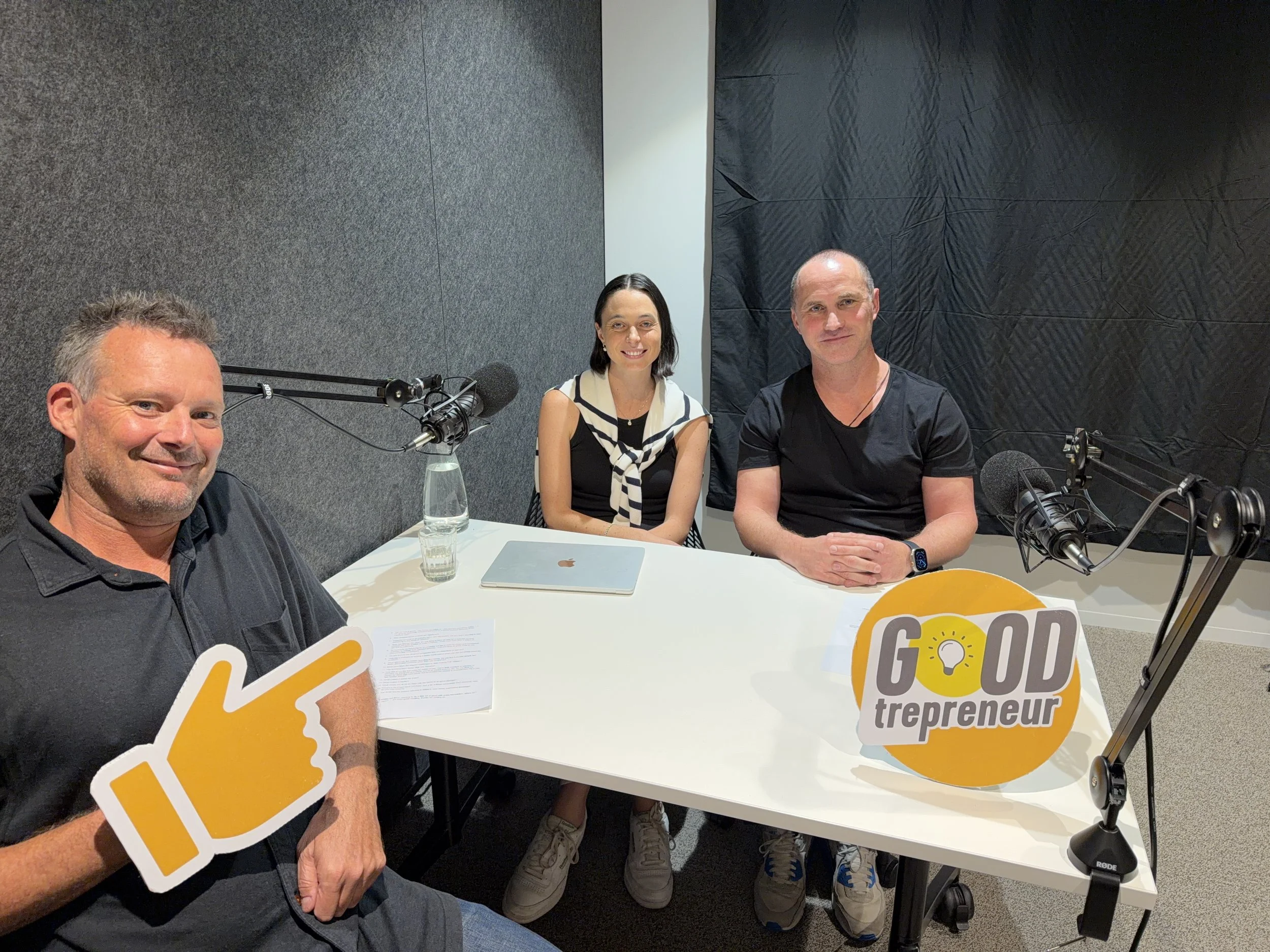
Recording in a very nice studio at Sydney’s ‘The Hub’ share working space
Full Episode Transcript
Ben: 0:04
Okay, so we can go. Okay, we're ready. Tap and click. Click and tap. Tap to buy a coffee, click to buy a book. Lunch, petrol, the electricity bills, tickets, beer, new climbing gear, something to wear or a new do for your hair. Every single day we Australians make over 23 million purchases by tapping and clicking. And every year this adds up to over $80 billion worth of stuff. With transaction costs of up to 3% per sale, that's over a billion dollars a year going into the pockets of the people who process the payments. People who, let's face it, probably aren't short of cash. Maddie and Glenn have a good idea. What if, instead of helping rich people get richer, some of those transaction feeds went into enriching our environment by planting trees and restoring ecosystems? That's how Green Pay works. And they're here to tell us all about it. Welcome, Maddie and Glenn.
Maddi: 0:59
Good to be here.
Glenn: 1:00
Thanks for having us.
Ben: 1:01
That's a pleasure. So how did you come up with the idea for Green Pay?
Glenn: 1:05
Well, I think the idea for Green Pay has probably been 20 years in the making in many ways.
Maddi: 1:11
But you're only 26 years old. How's that possible?
Glenn: 1:13
Well, exactly. I started to be able to do it. Well, I started young actually. My mum used to take me out walking around the streets in Auckland and in West Auckland, getting petitions signed to stop overdevelopment and the cutting down of the rainforests in that area. So it actually did start for me, probably at about the age of six. Alas, I'm not 26 now, so it was longer. Just turn 27. But yeah, I came to Australia in 2007 and had had some experiences when working in the UK. I'm originally from New Zealand, but had some experiences working in the UK, which made it clear to me that the trajectory we were on from a consumption perspective and from a environmental sustainability perspective wasn't sustainable. And then over the subsequent years in Australia, I tried a bunch of different things to find solutions to that, including working for the government for a period, working in big business and sustainability teams for a period, working in startups. And I think the big thing I took away from that is the scale of the issues we face are immense. And if you're going to tackle those, you need to tackle those with an idea that's got equal scale to it. And for me, that meant something that worked within the reality of the commercial world we work in, within the reality of capitalism. And so I'd kind of clocked in my head a personal purpose, if you like, which was how do I help people buy a better world? You're not going to give a better world, you're not going to kind of donate a better world, but how can you buy a better world? Because ultimately I think that's what we need people to do. And that led us to the idea ultimately of green pay, which ironically is exactly where the transaction happens. You know, we've lost 73% of biodiversity globally in the last 55 years. That's 73% of the birds, the bees, the trees, the fish gone in 55 years.
Maddi: 2:56
It's probably more than that now, to be honest.
Glenn: 2:59
It may be. That's a stat from uh WWF. And so if we're going to tackle a problem of that kind of scale, we need to find a solution that can equally scale. And that's what sits behind Green Pay. And what about you, Maddie?
Maddi: 3:13
We met at the company I was previously working at before Greenpay, which is a company called Verve Super. It's a for-purpose super fund. I had just started, I think I was in about week two or something there. And we were launching a new product at the time. Glenn was sitting on our board and has a background in brand strategy, go-to-market marketing. We then, fast forward kind of 18 months or so, went through an acquisition. So Verve was sold to um quite a big uh green super fund called Future Super. And so got to work quite closely with Glenn and the rest of the board. After I decided to leave Future Group, as it became, I reached out to Glenn for advice. And I think our 30-minute session quickly blew out into an hour plus, something like that. And he gave me all this really great advice, absolutely none of it, which I've taken up, because right at the end he was like, but I'm also doing this thing and we should maybe talk about that because it feels like it could tick quite a few of the things you're looking for. And so he then pitched me what is now Green Pay. And straight away I could see how it could work and I got the vision and I was excited about it. And I was excited about the chance to work more with Glenn. And so that was kind of for me where it all started.
Ben: 4:26
So tell me how Green Pay works. You know, I tap my coffee or I click and buy something online or other transactions. Obviously, not everything is a you know end consumer. There's business transactions, and a percentage of that goes to Green Pay instead of, say, F POS or one of the other players or similar gateway. So is that how it works? And if so, then what happens next? How does this money end up helping? How does the money flow? Yeah. Where does this money flow?
Maddi: 4:48
Where does the money go?
Glenn: 4:49
Yeah, so the truth is it's kind of complicated behind the scenes. There's all these different players and payments. You've got Visa, MasterCard, MX, you've got a bunch of different players, interchange fees, scheme fees. There's a lot of things going on in the background. But ultimately, every business, be it a retail business, be it a university or a council, be it an energy company, be it online or offline, if they want to take payments from their customers using credit cards, debit cards, F BOS cards, or even direct debits, they need to work with a payment processor. And that's what Green Pay is, a payment processor. So typically when a business is paying that one or two percent, or sometimes to passing it on to their customers, we take a small percentage of that percentage, is ultimately what happens. And that that ultimately will lead to our profit. And then from that profit, we're giving 50% of it to the Green Pay Foundation. We talked about scale. And in in the Australian economy, each year, there's about four or five trillion dollars that go through the payments ecosystem in one form or another. And so the idea is if we can take even a small percent of a small percent of that and recycle that back into nature rather than recycle it into the bank's profits, who then typically do things with it that maybe we don't all agree with, or send it to some kind of offshore tech company where it ends up in the hands of Silicon Valley investors and the like. The whole idea of Green Pay is rather than the money ending up there, it ends up back in Australian nature to help protect and restore it. So we say our purpose is to put nature at the center of every transaction. Ultimately, it ends up at our foundation where we've got a great board. Um, so we've been able to attract some really, really highly credentialed members who help advise us on what happens with that. So we have uh Rachel Laurie, who's the CEO of Bush Heritage Australia, um Darren Grover, who runs all the land-based conservation for WWF, and um distinguished professor uh Michelle Leishman, who's one of the world's best-known plant ecologists. So that group helped guide us as to where that funding should go.
Speaker: 6:49
They're awesome. They've been so great.
Ben: 6:50
And do you have like specific projects that you think are more important? You know, restoring nature is pretty big conversation, you know.
Maddi: 6:58
It's a big goal, we know. We're focusing particularly on kind of the biodiversity space, because a lot of the soul for climate change actually is within biodiversity and within regenerating or protecting nature. So initially the foundation is focused on what we call the here and now. So that's kind of things we need to solve today. And so that might be, and I'm I'm making these examples up, I'll I'll tell you what we have supported, but examples of that could be there's been a bushfire and a koala hospital urgently needs some funds in order to protect the koalas in the area. Or it could be um there's a piece of land coming up for sale that's been really degraded, but it has a really precious ecosystem of some form in it. So, how do we support an organization to purchase that and then protect it for its kind of lifetime? So that's sort of the here and now. And then over time, we hope to, as we scale, run our own projects. So be the ones that are delivering that body of work, but then also relying on Glenn's background in kind of this impact VC space, make investments into companies that are solving these problems long term. So perhaps they're developing like a new type of plastic that isn't reliant on fossil fuels or um some other kind of systems change that we can see could be really impactful if it's scaled. So that's the vision for the foundation. We have already made four donations. So the groups that we've supported so far are half-cut in partnership with Jabel Binner. So they're the um indigenous owners of the Dane Tree area, so the world's oldest rainforest. And so they do a lot of work again around purchasing back pockets of that rainforest and then protecting it while also bringing um the local people back onto land and connecting with country. So we were lucky enough to go up into the Dane Tree um a few months ago and really learn from them about the work that they're doing up there. And it's really powerful. So I'd encourage anyone that hasn't been up there to try and take a trip and visit the Dane Tree. We've also supported Gajuda, who's a group of indigenous rangers up in northern Queensland, who for decades have been doing really important monitoring of sea turtle populations. So they're tracking for population levels, illnesses, and then feeding that data back into a lot of the government bodies. We've also supported Bush Heritage Australia. So if you haven't come across Bush Heritage, um, they used to have a really great tagline, which is we don't beat around the bush, we buy it. And it just sums up exactly what they do. So they find pieces of degrade land, degraded land, or areas where there's a precious ecosystem, or perhaps where there's two ecosystems that just need to be connected with a piece of land, and they then raise funds to buy and then protect that forever. And so they do a lot of work with invasive invasive species or making sure that it's planted correctly, or, you know, whatever needs to be done in order to protect that land. And then the last piece was for Conservation Ecology Center, who are down along the Great Ocean Road and they're doing a lot of work into research around endangered plant species down there. So they're looking at the specific orchid where not much is known about it, but it's um endangered. So trying to figure out how we can protect that population before it's too late.
Ben: 9:55
That's fascinating.
Maddi: 9:57
It gives a bit of a flavor.
Ben: 9:58
Yeah, it's a great flavor, and it's it's a very active approach to what you're essentially investing in nature. I think I think it's fair to say that when a lot of big businesses, you know, do something, choose to give a percentage of profit somewhere, they generally just pick a partner and go, here's the dough, off you go. Yeah, kind of, you know, and then they take that logo, and that logo goes on some things in their sustainability report. But you guys have taken a very active approach to this to truly understanding the problem. Do you find that helps to define the company itself instead of going, okay, we're about payments and we give over here? It sounds like you know as much about the ecosystem restoration as you actually do about your own business, which is uh it means you've got to learn a lot more, but it also means you're a lot more the purpose of your business is a lot more embedded in your business.
Maddi: 10:43
I mean, it's literally in the name.
Ben: 10:44
It's true then.
Glenn: 10:47
And I think that's right. You know, our our objective is to create a sustainable source of funding for nature. And we've deliberately chose nature, not to solve climate change, not to do those things, which believe it or not, some people still have a belief system around whether that's true or false. It's really hard to find anybody that disagrees with you when you say we probably shouldn't chop down all the trees and kill all the animals. And we know that if we can save those ecosystems, that's actually a big part of the solution for climate change. What we aspire to be able to do, uh, you know, and we've been speaking to the Biodiversity Council, which is a little bit like the Climate Council. It's a group of 70-odd of Australia's leading biodiversity experts, and they tell us there's this funding gap. And if we could get about 1% of Australia's budget literally targeted to support nature, which by the way is what we all depend on. You know, it's funny the conversations we have. It's everything's about the economy. You know, uh jobs are up, jobs are down, inflation's up, inflation's down, interest rates are up, interest rates are down. The entire economy is just a construct of our society, and society is entirely dependent on the environment and nature around us. But we think about it economy first. We're trying to rewind that and actually think about if we don't have and we can't protect that environment, which would take 1% of the annual budget, is what the experts are telling us, then we've got a real long-term issue. And so we're trying to close that gap. At the moment, they're getting about 10% of what they need. So that's what we're trying to do. And I think we lean a lot on our board. We we've we're working with some really good people, some real experts, and and what they help us do is find these projects that are underfunded but have potentially really significant impact. And our aspiration is to be able to measure that, to be able to report on that, and to be able to talk to all of our customers about the good work that they're contributing to. So we start to build a real community around it and ultimately drive word of mouth and hopefully referrals and some loyalty. Because why would you choose a different payment processor if this one is at the right price, right technology, and it's doing that work for us?
Ben: 12:43
How much do you think that that story resonates with organizations when you go into them? I mean, you just mentioned a couple of reasons someone would adopt right price, easy to integrate, does all the things the other one do, plus it does this. What order is the importance for an organization? And does it depend on the organization?
Maddi: 13:04
Absolutely, yes. I think it absolutely depends on the customer. So when we're talking to our more impact-focused organizations or sustainable organizations, the green part is the leading message of that story or that sales pitch. For other organizations, we lead with technology or we lead with cost. It depends on what that company's immediate priorities are. As kind of Glenn mentioned earlier, what we do try to do is lead with nature because pretty much everyone in this country has some connection back to the outdoors or to nature. It's the hike they went on last weekend, or it's their kids' game of sport that they watched on the weekend, or it's, you know, the annual fishing trip they go on with their high school buddies or something. And so I think trying to reframe it as their connection to nature. And then we're trying to protect and restore that so that you can continue to go on that annual fishing trip with your high school buddies. I think that's the connection that we always try to get to, even if they're not per se an impact-focused company.
Glenn: 14:01
I think probably one of the key learnings that I've taken out of the last 15, 20 years, trying to find ways to have a positive impact. And in particular, over the last six or seven in the venture capital space, looking particularly at companies that are trying to have a strong commercial return, but also a measurable and demonstrable impact on the environment. Is I think you earn the right to have a positive impact. And you earn the right by first and foremost having a product that stacks up that's at least the same, if not better, than competitors. And it has to be priced at least the same, if not better, than the competitors. And if you can do that, then you can actually earn the right to have a conversation around this is a positive impact we're making. And I think we've seen that in industry after industry. You know, the very first kind of green cleaning products, they were great, but they didn't clean.
Maddi: 14:50
It's not really good though.
Glenn: 14:51
Trevor Burrus, Jr. And so and they cost more. And now I think we're getting to a point where in that area, you know, you're now getting products that are genuinely cleaner and and do clean and are at the right price. You know, same in the EV land. You know, EVs didn't take off until actually the prices start to get down to the right level and the functionality of the car matched a traditional combustion engine. And I think it's the same. It's the same in payments. Um we set out absolutely from the start to say that this is not going to be a concessionary decision. You're choosing green pay because it's going to deliver you a world-class experience from a payments perspective. We can match or beat the price of the the big banks or any of the other big technology providers out there, and we can give you this positive impact that you can make for really no effort on your part. You know, 15 minutes or so. It's like it takes 10, 15 minutes to sign up for most people, and we can integrate it and implement it and away we go. So that we try to make it as easy as possible. Effectively a bit of a no-brainer.
Ben: 15:48
Because it is, it's one of those products, isn't it? That it's not the product. It's the I mean, in insurance they call it a grudge purchase. You kind of got to buy it. You know, I didn't really payment so and in like uh logistics, it's like getting something from A to B. I I didn't want to pay for it, but I kind of have to. So it's sort of a low interest thing for people, which in some ways can be beneficial because they're like, well, as long as it works, it it you know, it doesn't matter. But at the same time, it's like, gee, I've got 50 things to worry about and I already had one set up and this wasn't it, you know, this wasn't on my list. Do you find that the provocation of, hey, why don't you have something just as easy, better price as you said, and I'll give you stories of hey, you're doing good. You know, if you were just a company coming in without the do good and you were just a bit cheaper, they might go, it's just not worth the hassle. Do you find that appealing to the higher purpose does get them over the line if you can tick those other things?
Glenn: 16:40
Um, I'd say yeah, yes and no. So um, you know, for some of our customers, they're just like, hey, the price is right, great, I'll take it. And, you know, it can actually be take five minutes to do the sale. For others, we can demonstrate the technology is actually superior to your existing technology. We can save you money, and still there's inertia there to try and get them across the line. And I think, you know, it's interesting. I think what we're experiencing is, you know, whilst we're signing, you know, we've signed up 50, 60 customers in our first year. We've got some dream customers on board already. We've got the likes of Ben and Jerry's that have signed up. We've got um fresco keep cups that have signed up, we've got Planner Arc in the environmental space, and we've got a whole host of, you know, local mechanics and florists and and and others that have signed up. The interesting thing, though, to your point, is they don't have a problem because they have a payment solution that works.
Maddi: 17:30
On the whole.
Glenn: 17:30
On the whole.
Maddi: 17:32
There's a few out there.
Glenn: 17:33
There's a few where it doesn't. But they have a payment solution and it works. We can offer them a payment solution that equally works, sometimes even better, at a price that's even better, and we can do this great thing for nature and for society in general. But oftentimes that's you know, that's still a challenging conversation. And it takes us a few go-arounds oftentimes to convince people. And I think the issue is they don't have the problem, but the environment is everybody's problem, but nobody's problem. So in some ways, we're solving arguably the biggest problem, but it's nobody's problem. And that I think is in many ways a microcosm of of what we face in society and the environmental movement in general. And I don't even know why there should be an environmental movement now that I I think about it, like it it just should be natural to protect the thing that we rely on. But uh it seems that there's a movement that's required.
Maddi: 18:21
It's that feeling of everyone's waiting for someone else to solve the problem. And they don't realize that they can all be taking steps like implementing green pay, but also like doing any number of other activities to help solve that problem. But I think they're all hoping someone else will just come along and snap their fingers and they'll never hear about climate change again.
Ben: 18:37
The magic they should fix it. Yeah. Well, uh uh tell me about that then, because obviously, I mean a lot of your stuff is B2B payments, but there's you mentioned florists or the local garage in there somewhere too. So at some point there are people using little portable F buzzes, there's actually one on the table, as we speak. And that's the end consumer. So is there a situation where two cafes next door to each other are essentially selling the same coffee or two florists, similar flowers, but one uses green pay and one doesn't? Do you find you can get that consumer pull through where people will go, well, well, of course I'll buy that cafe? Because every day I spend my five and maybe six now bucks on a coffee.
Maddi: 19:14
That's the other date for me. Oh my goodness, me, where are you? I was in circular key, it was my mistake.
Ben: 19:19
Um, that over the year, maybe they've just donated, I don't know, 20 bucks through their little 1%. Do you find that consumers will engage with this, or is it really just about getting the retailer interested?
Maddi: 19:32
Definitely the retailer, because the more enthusiastic and passionate they are, the more enthusiastic their staff are. And so, you know, we have some customers where their staff doesn't even know there's anything special about Green Pay. And then when I've explained it to them, if I've happened to be in store, they then get really excited and I hear them tell the next customer kind of as I walk out the door. But I think on the consumer side, we are still a new business. We've only been in market for around a year. So I think we yet to have that really wide brand recognition that we hope to have, you know, tomorrow, but soon. We'd love to basically get to the point where not using green pay is embarrassing for a business. And I think about it, the example I think about is when you used to go to a restaurant, the toilet paper would be hidden away in a cupboard somewhere. Whereas now, if you go to a restaurant, they've like proudly displayed their who gives a crap or one of the other social impact toilet paper brands like on top of the toilet or in the cupboard or kind of on the shelf in front of you to say, like, look, we're doing the right thing. We've chosen the impact-focused toilet paper. And so eventually we wanted to get to that point where businesses, it's like, oh, why aren't you using Green Pay? Why would you not be using that solution? And then we do find that obviously surcharging is quite a hot topic in the media right now. And I talk to businesses every day, and every day they go, Oh, yeah, you know, customers complain about the surcharge. And so I get to say, well, well, wouldn't it be nice that next time that happens, you have a really positive story to tell that customer about yes, we're surcharging, but instead of it going to a bank, it's actually going back to nature. So by paying that, you're supporting Australian nature.
Ben: 21:01
That's an awesome story. I can easily see that we use green pay sticker on the inside of the cafe. But I can also see over time that cafe being able to quantify just how much ecosystem it's restored or whatever through those payments. And then you can aggregate the story upon story in that sort of thing.
Maddi: 21:17
The data that yeah, the amount of analysis we'll be able to run, excited for someone else to do it.
Ben: 21:23
I thought you were going to say you're excited, but so take me back a step. You know, you mentioned this industry is fundamentally big banks and tech companies, which in this day and age the tech companies are bigger than the banks, you know. It's an industry full of some very big players. And well, maybe you have some experience in financial services, and Glenn, you've got experience more broadly in startups. I mean, I don't think either of you really were like big bank people, but you're taking them on, you know. It's really a world of Goliaths. Did you find that daunting to start something going, I can take on these big players? David beats Goliath, doesn't he, in the story.
Glenn: 22:01
That's true. Certainly does. I guess David's our inspiration here. Look, in many ways, it it is daunting and it's incredibly competitive. But there's kind of two different ways of thinking about a startup. You can try and invent something entirely new. And then if you are successful inventing that, you maybe have a virgin market to pursue. Or you can say, actually, there's a market here where I know for a fact there's product market fit. I know for a fact there's tens of thousands of merchants around Australia that need a payments processing option. And so then it just becomes a competitive game and a story game. And so as long as we can match on the functionality and match on the pricing, or and as I say, nine times out of ten actually beat, then it feels like David's got a good chance against some of these glides.
Maddi: 22:47
I heard a really good quote yesterday, and I honestly can't remember who told it to me, which is quite embarrassing given the timeline on that. But it was a startup either disrupts competitors or it disrupts a whole industry. And so to link it back to that, we hope one day it'll be embarrassing not to use Green Pay. We like to think we're disrupting the whole payments industry rather than one specific competitor.
Ben: 23:07
That's a fair point. And um, I like your analogy of like if if everyone's essentially offering a commodity product and you're the only one with the story, well, that's a very big rock to your David Calife. And that's it's interesting because I would have looked at this if it was me. I mean, I find a lot of uh founders actually enter industries they have no idea about and they just learn about it along the way and they kind of figure it out. But I love that you've sort of entered instead of going, oh my God, how do I take on the big guys? It's like, I got something big guys don't have. And I can figure out the big guy stuff. It's quite a it's quite an a um gutsy approach, really, isn't it?
Maddi: 23:41
That's the beauty of a commodity.
Ben: 23:42
Yeah, it's the beauty of a commodity. You can differentiate a commodity.
Glenn: 23:45
Absolutely. Uh you know, we've talked a little bit here about who gives a crap, but that was an inspiration for us in many ways. You know, toilet paper and and payments, like what do these have in common? Very different things. But you know, everybody needs both of them. And in many ways, they are somewhat commoditized. They solve problems. You know, wiping our butt and making a payment does solve problems. And so if you can wrap a story around it and do something good with that, then I think that's the opportunity.
Maddi: 24:12
I think you just got the tagline for the episode wiping our butt, moving money.
Ben: 24:16
What does toilet paper and transactions have in common? Um speaking of well, speaking of who gives a crap. I mean, that the anybody doesn't know that he started by getting crowdfunding by sitting on a toilet till he'd raised enough money to start his company. How did you start? You had the idea, you obviously met, you've pitched Maddie, who's gone, great idea, let's do this.
Maddi: 24:35
But then First Believer right here.
Ben: 24:38
Um Lone Nut, the first follower is more important than the person with the idea. Exactly. Watch that video. Where do you begin? You go, great, I'm gonna create a payment gateway system. What's step one?
Glenn: 24:50
Yeah. Um you've got to start talking to people in the payments industry and start to try and understand it. And there's obviously a huge knowledge piece there. And you know, in many ways, it's been like drinking from a fire hose for the both of us for um for the last two or three years, learning about the payments industry. Interestingly, it's so complex that not everybody really understands all of it. You know, so you can catch up quite quickly if you know who to talk to. And I think we identified early on, there's basically two ways of building this company. You go out to the venture capital community and you try and raise $100 million, build a team to build your own system from scratch and take that to market, or you go, actually, this is a solved problem. There's two or three very large kind of technology infrastructure providers around the world that that actually have the rails built, have the technology that we could potentially partner with and work with to do that. And so that's the route we went. And um, we have a bunch of different partners now that we work with that enable us to actually confidently walk into a meeting and say, we can beat your offer with a bank or we can beat your offer with name the payment company, because we actually have the scale and the technology behind us through those partnerships. You know, curious meetings, some of those where you go into some of the world's largest payment processes and you talk about. So our idea is we want to uh to utilize this technology and we want to to win customers and then we want to give 50% of the money away to our protect and restore nature. And you get the odd curious look at the start, but then actually people start to go, oh, that where I live, there's actually this park that would be that they're trying to do some work on that and they can't get the funding. Maybe, you know, if it works, we could we could donate a little bit there. And and people start talking about it around the boardroom table in their suits and ties. And then eventually, yeah, actually, we could make this work. You know, and we can partner and we can we'll we're happy to support what you're doing. So we're very lucky with the partners we have and the support we have behind us that enables us to take on Goliath. Um, a couple of Davids and Davett's Davina.
Ben: 26:48
Davina.
Maddi: 26:50
David.
Ben: 26:51
It's so interesting that though, isn't it? Because the, you know, people assume that, you know, a bank is just in it for the money, but a company is just a bunch of people, fundamentally. And it's so interesting that what you're doing is they must just live their whole life if it's all about money. And you've just triggered something in them to go, oh my goodness, we could still be all about money, but I could actually let a little bit of my soul in here and do something good for the world. Have you found that that has helped you get partners? You know, people almost almost I mean, I hate to say, but people who are almost like, I wish I could have some more purpose in my world, other than being about money. And does, you know, does that help get these partners on board that you might not have expected to have any interest in this space? It sounds like it does, from what you say.
Glenn: 27:32
I think what they see in Green Pay is a unique proposition, like a clear problem and a clear passion point for us, for Maddie and I. And as you take that amount of passion and a problem of that size, you know, ultimately they know that we're gonna give absolutely everything to make it work. And that's really what any large company is looking for in a partner, is a partner that's gonna work really hard, that's gonna give it the best, best possible chance of success. And I think that's what people see in Green Pay. And I think it's why doors do open 100%, you know, in many ways that they will open for us. And I think if there wasn't that story, why would they open? You know, you you're just another commodity.
Ben: 28:13
And for you, Maddie, how much? Well, for both of you, how much does obviously starting a company? There's got to have been some pretty solid challenges along the way. I'd love you to tell me what some of them are. But I'd also like to know how that commitment to purpose and that feeling that you're doing something good in the world helps you get past those problems, just sort of on a personal level, you know, when you get that email at 10 at night that you didn't want and going, it's okay because I'm doing something I believe in, you know.
Maddi: 28:39
I think, I mean, do you want to talk to that one?
Glenn: 28:43
Sure. Um I'd say a couple of things in response to that. Uh our biggest challenge is um, let's say there's two, maybe three actually. There's always three. There's always a three. Somebody once told me that in my advertising days years and years ago. There's always three. Just say I've got three points. And by the time you get to the second, the third will emerge.
Ben: 29:04
That's a real thing. Well, I use that rule regularly. And the reason is that Johnny Cash said three is the magic number. Who am I to argue with? Who are you to argue with?
Maddi: 29:11
That's wisdom, right there.
Glenn: 29:12
Yep. So look, our our biggest challenge is uh uh overcoming inertia. So we've talked a little bit about that. Despite the fact that you can offer a better product at a better price, still it's hard to get people to just pick up the pen and sign the form to sign up. And it's it's it's similar, like it's you know all of us struggle with that. You know, you there may be a better offer for your mortgage where you can save half a percent or something, but can you quite be bothered doing it? It's clearly better for you. But still there's this inertia and this distraction that we have to cut through.
Maddi: 29:47
That was super familiar to me as well, coming from superannuation, because uh I think if you talk to almost anyone in Australia, at some point or another, they've had on their to do list review my super fund, whether it's for fees. Or whether maybe they're a more sustainably minded person and they wanted to switch to a sustainable fund or for whatever reason. And yet it was probably the biggest point of feedback we heard at Virve, which was like, oh yeah, I've been meaning to do that for a really long time. We're like, do it.
Ben: 30:13
I heard a stat once that you're more likely to get a new partner than to get a new superfunder.
Maddi: 30:18
That honestly doesn't surprise me. Like it was on my to-do list for about five years before I started at Virve. And then I went, Oh, it's probably time for me to do this. It's looking a bit embarrassing now.
Glenn: 30:28
Yeah.
Ben: 30:28
Um, so basically I've become a notion that's challenge one. Uh there are three, I hear. Oh, yeah. How did you know?
Glenn: 30:35
There's three and a and an addendum. Uh I think the other thing for us is is focus. So, you know, we're a relatively small team. We've got an incredibly large team behind us of technologists and experts that can help us and huge amount of customer service support behind us. So we've got in many ways thousands of people working for us, but ultimately it's up to Matty and I to guide the ship and trying to figure out where to focus when actually we have a product that could pretty much satisfy any business, any not-for-profit, any organization in Australia taking payments, we could pursue. So where do you start? That's one of our challenges. And I think in in year one, we decided to not necessarily answer that upfront. Like let's go out to market and let's uh try and understand where where the doors are ajar, where they might be a little bit more firmly closed. And then I think now as we move into year two, we're really starting to focus on where those doors are ajar, if not open. So that's been a big challenge, trying to figure that piece out. So the strategy there is literally just trial and error.
Maddi: 31:32
For the first year. For the first year. So yeah. That's ended now. I think when we had our last kind of strategy session, Glenn said something that sat with me, which is strategy isn't just about what you do, it's what you don't do. And you have to make really deliberate decisions about what you're not doing. And so for us, year one was a little bit of like do everything and see what works and see what shakes out and yeah, see where the doors are open. But I think coming into year two, it's like, okay, what worked, what didn't work. How are we being strict with ourselves around where we spend our time so that we can have like scale the fastest?
Glenn: 32:03
Excellent. Which leads neatly to point three, which is scale. You know, how do we scale our team? How do we scale efficiently? How do we make sure every dollar we invest, we're getting a payback on? And I think that's linked to that second point there around focus. And how do you scale? Great question.
Maddi: 32:19
Do you have the answer? You're the expert.
Glenn: 32:23
And maybe just back to your point about purpose. You know, one of the things that certainly for me, and I think it's the same for you, Matty, but I'll tell my story, you tell yours. You know, when you've got to make that call to that customer for the fifth time or tenth time because 12 for one I'm chasing currently. You know, because you just they you need to get them across the line because you believe so much in the solution for them, but you also know that it's not about necessarily making money. It's not about the payment solution. It's ultimately about we've lost 73% of biodiversity since 1970. It makes me lose all my shame. I'll unashamedly call you again because this matters. And I think when you're doing it for something that means something to you and and frankly should mean something to everybody, it gives you an extra gear. And I think that's been really important for us.
Maddi: 33:14
Yeah, I'd agree with that. I think I'm naturally not a super pushy person, especially in like a professional or work context. But yeah, I think it's it's the motivation to just try that one more time.
Ben: 33:26
Well, when's call 13 after this?
Speaker: 33:28
Call 13, probably tomorrow.
Glenn: 33:31
We've we've really lent into sales. You know, it hasn't necessarily been our backgrounds. We're not sales professionals per se, but we've really lent into it because we now have something we really care about selling.
Ben: 33:42
And that makes all the difference. And do you find being on the forefront of sales means you're talking to customers, therefore you're more likely to better understand how to develop your product.
Maddi: 33:51
100%. Especially now that we're focusing in on niches. Like I'm finding now that I'm using the terminology that they use. So, you know, like if I've just spoken to a mechanic and then say I go to call another mechanic or something, it's like, oh, you know, I'm talking about the workshop or whatever. It's like you you start to kind of learn the lingo because you have enough conversations with them, or or you learn the people that they're currently using. So you can go, oh, you're using that provider. Are you finding XYZ thing? So yeah, you do really kind of double down on the language. Though I have to admit, I did go to a mechanic yesterday wearing a white skirt. So fail number one.
Ben: 34:23
Don't lean in anything. What's been so there were your your three big challenges and and how purpose helps you overcome them in some ways. But what's been easier than you thought along the way?
Maddi: 34:34
I think I mean a whole bunch. Like we have had um such amazing conversations with people where we explain what we're trying to do. And I've had multiple people say to me, This is just such a good idea. I can't believe it hasn't been done before. Like it just it makes so much sense when you explain it to people, like taking a tiny little clip of every transaction. If you could do that across Australia, it just makes sense. And so I think that was really validating, especially in the early days when that was kind of the first validation we were getting. That was amazing. And then I think we've just had a lot of interest, like a lot of amazing companies that have either reached out or, you know, a friend or a colleague's mentioned to them. And we've had meetings with companies that quite frankly we didn't expect to be speaking to, especially in year one. And then to have some of those come on board in year one is insane. Like we have companies like Ben and Jerry's who, when we started, was a dream customer that maybe in year five we thought we might speak to type thing. And, you know, they were an early adopter for us. So I think to have people that were on our wish list believe in the vision, believe in the team and get on board and, you know, improve their payments in some way was amazing. And then I think another one that I probably didn't expect was just like the strength of our foundation board. So having those experts leads credibility to what we do on the impact side. And I think we can then speak with true authority around the fact that we know that that money will do good because we have such wonderful people on that board, but they're also just excellent humans and you know they're really great to work with as well. I don't know. Did you have any others? It's all been easy. What do you mean? That's what startups are known for, just easy.
Ben: 36:07
Yeah, nice, relaxing kind of a lifestyle.
Maddi: 36:10
Yeah, really chill, you know, 10, 10 to 4 kind of hours. Yeah.
Ben: 36:13
Oh, you're working long late.
Maddi: 36:15
Yeah, so that's a big day for me. Sorry.
Ben: 36:18
Now, this is not really the first rodeo for either of you. A lot of startups are first-time founders. You're both mentors or coaches to startups via Startmate in Australia. And Glenn, you're actually an impact investor yourself. Overall, you know, we need more good ideas from more people succeeding more often. Do you think it is harder for these ideas to get up and running than let's say someone who's just found, you know, the latest woody, the latest fast fashion thing that all the teenagers are going to want? Is it an extra dimension of difficulty one places upon oneself to become a startup founder that's trying to do some good in the world? Or do you think it's easier in some ways or is a mix of both?
Maddi: 36:57
I mean, you're speaking to the man who's seen about 3,000 impact startups. So you really came to the expert with that question.
Glenn: 37:04
I mean, the facts show it's hard for all new ideas, all new startups. That's the reality of it. Um and I don't think, you know, maybe the exception might be if you're a startup AI company right now where people are throwing money at you. But outside of that, every startup is a journey. Every startup's really hard. Every startup that I've seen or experienced or observed takes longer than you think. That hard. That that hard. Um I don't think it's necessarily been any harder or any easier for us in many ways. The easy bit is because we really care. And so it doesn't feel like work. It feels like Well, you're only doing 10 to 4. So that's the long day, please. Um You know, it feels like it does legitimately feel like we're on a mission. We're on a mission to put nature at the center of every transaction and change that paradigm and turn everything, that every payment into a force for good. And in many ways, I think that's the future of stuff of startups. If if there's not a future of business, you know, if it's not ultimately a force for good, why does it exist? And when you look back in business, some of the greatest companies or the most famous companies of all time did start out that way. You know, the Unileavers and Procter and Gambles of the world, they started out trying to solve sanitation issues and cleanliness issues. They they all started there. You know, the Cadbury's, the Nestle's, they did the same thing. And then maybe some would argue that they've wavered somewhat over time. But ultimately, I think every business needs to be and should be that force for good.
Maddi: 38:31
I think there was a stat I saw the other day that was 73% of Australians expect businesses to be doing all they can to be environmentally friendly. And so it's like this is now not just a small group of people that expect businesses to be doing the right thing. Like this is the majority of Australians, and businesses are seeing that and responding to that. And with regulations coming in, it's becoming even more and more important.
Ben: 38:53
Do you think, based on that, are you seeing more as as mentors to startups, are you seeing more and more that almost every startup has its some sort of social and environmental sort of cause behind it or value behind it? Seeing a lot more. Yeah.
Glenn: 39:07
Seeing a lot more. You know, uh riffing here a little, but but I think there's a whole genre which you could probably fit under that umbrella. Certainly a lot of the startups, in fact, all the startups that I look at fall under that umbrella. They're doing something in the environmental sustainability space. Companies like Ulu trying to create um plastic from seaweed that biodegrades in the ocean, companies like Amber, which are changing the way that we interact with our energy, being able to offer wholesale and give people the real value of the renewables that sit behind it. They all fit in that category of doing something with real impact. And then I think there's a bunch of companies that are really on the cutting edge of tech. And they're they're they're looking at a piece of technology that's come out and gone, how do we utilize this for good? And maybe they haven't quite figured that out yet. But it's like, how do you get that into market? You know, and that I guess that's the thing with impact. You know, what is impact? What isn't impact? Some would say Google's maybe the most impactful company in the world over the last 20 years. It's provided free services to almost the entire global population and lets you get any information you want at your fingertips instantly for free. You know, what is what is an impact? I think is an interesting debate. What I would say is bar none, all those products, first and foremost, need to offer great solution at a price that's right. And then the impacts, the cherry on top, it's the icing. I think if you start the other way around, it's very challenging. I think that's probably the big level.
Ben: 40:32
So that's interesting. So obviously, in your case, the whole purpose, nature at the heart of every transaction is the beginning of the idea. But then when you come to developing a product, it's really got to be the best in the market. And then you might kick them over the line with the purpose again. So it drives you and it maybe drives the sale, but it certainly isn't the middle of the funnel. Correct.
Maddi: 40:52
I would say to answer kind of your original question, I think for an impact business, it's much easier to build really deep loyalty. Like I think any business here or there can have a little problem. But I think having customers that have bought into our mission means that they're like if there is a small niggle, they're more willing to tolerate that because they believe in what we're doing and they're willing to give us a second chance. Or, you know, if they're not looking to switch a payment processor, but then we come in with the story, they're much more willing to give us that meeting and give us that consideration because they can see what we're trying to do. I think it's just a lot easier to build community, build referral networks and build that deep, deep loyalty with an impact brand.
Ben: 41:30
Do you also find, like obviously, one of the challenges, any business, you want to stay top of mind with your customers. You know, someone once, I was talking to someone once about marketing, and we just he just said it's all of the above and the whole goal is top of mind. You know what I mean? And and the challenge when you've got something like a payment game is how many times can I say, hey, we do a payment game? You know, whereas when you're then investing in nature, you've got infinity stories about the nature you've you've helped. So you're able to go back and go, look at this story, look at this story. So your ability to actually market yourself and stay top of mind is totally different to somebody else who doesn't do this.
Maddi: 42:03
For sure. And yeah, there's only so many times you can see photos of terminals before you unfollow that Instagram page, you know. Whereas, you know, hopefully with us, you're getting kind of a little bit of environmental inspiration, but then you're also maybe getting a little bit of existential threat every now and then to keep some urgency in mind. Um, and then you get a payment terminal. So, you know, there's variation. Um but it's absolutely true. I someone told me, wow, I'm just really pulling out the quotes that I can't remember the source on today. Um, but yeah, someone said to me the other day, you have to be seen seven times to be remembered. And so I think it's something we're always talking about is how can we stay top of mind on different channels without stretching our small team too thin?
Ben: 42:40
Okay, two more questions. The first is about you both. Obviously, in this busy 10 to 4 world of working hard.
Maddi: 42:48
That's gonna be the headline now. Lazy founder.
Ben: 42:51
Or 10 a.m. to 4 a.m. Yeah, yeah, sorry. It's probably more like it, isn't it? 10 p.m. to 4 a.m. Like the startup. You know, obviously startup world is. There's infinity work to do, as you say, and you've got to decide what you don't do. How do you keep your own personal sustainability in that? How do you make sure that you're not, you know, drawing on your own personal capital and have the energy to come back every day?
Maddi: 43:14
I think there's there's a bunch of things that I think about. So one is I'm starting to think about life a little bit more like seasons. And so I think you know that sometimes you'll have a really hard burst, you know, say we've got, you know, a really big sale on or something. It's like that's okay to flex those hours that week as long as you do find time, whether it's cancel a plan on the weekend, sorry, to all my friends, or whether it's, you know, start a little bit late one morning so you can go for a slightly longer walk or something like that. So I think it's being aware of when you have had a really busy period and making sure that you kind of catch up on that. For me, there's also just the rituals and habits, which if my friends are listening to this, they'll laugh because about once a month I get a text saying, wow, I went for a morning walk and everything's so great and life's good and I feel so positive. And I complimented a girl and her outfit on the train or you know, something like that. They go, Oh, okay, we're back here. You know, good, great. So clearly I've stopped doing my morning walks and I've been in a grouchy mood, and then I start doing them again, and then you know, the world's colourful again. So I think for me it's just sticking to those habits and those things that I know keep me centered and keep me grounded, but also bring me joy. And then yeah, all the classic like sleeping and spending time with friends and family and you know, unwinding before bed, all those lovely things that I preach and do about 50% of the time.
Ben: 44:24
That's pretty good. Glenn, do you compliment people on their outfits on the train?
Maddi: 44:31
He takes the ferry, so you know, he doesn't have the opportunity.
Glenn: 44:33
Yeah, I tend to stay away. It's probably creepier coming from me. From Maddie. I think what there's a couple of things for me. One is I think I'm now old enough and uh I've seen enough and only 26 years old though. Yeah, 26. I'm really conscious that I would much rather give it a red hot go, give it a crack. And even if it doesn't work, that's a much, much, much better outcome than not having it go. And you know, I've got a a young daughter, and she actually helps solve that get me away from work thing because she doesn't care. Um, she just cares about the little dog or whatever else she's chasing next.
Maddi: 45:10
The definition of being mindful in prison.
Glenn: 45:12
Exactly.
Maddi: 45:13
She's nailing it.
Glenn: 45:14
She's nailing it. So I think that drags me away from it, but also in some ways motivates me to keep going. I like I I think once you've you know dedicated yourself to something, it's very hard to think about what else you could do. Like there really isn't a plan B for the planet either.
Ben: 45:32
True that. No plan B for the planet or Glenn.
Maddi: 45:34
Or Glenn.
Ben: 45:35
This is gonna work. It's great. So obviously, we need more people out there doing more good things like this more often and succeeding. So three top tips. Or it doesn't have to be three. We did set that right.
Maddi: 45:49
But there are always three.
Ben: 45:50
But there are always I know you're gonna give me three, so I'll just ask for three. Three top tips for anybody thinking of beginning.
Maddi: 45:57
Okay. I mean, I would have so many tips, but the ones that kind of initially come to mind for me is first is thinking through the business model. I think there's something beautiful to be said for Greenpay's recurring revenue model, which is that effectively with every new customer we get, assuming zero churn, that's more money coming to the business and therefore more money going back to nature. So I think there's a reason VCs have been pushing people to find recurring revenue. And I think it it truly does help grow a business faster. The second one is to find something you give a shit about. I think as we've touched on, like founding a business is hard and there will be times where it could be easy to give up or to not work that day or to to not pick up the phone for the 13th time. And so I think as we've talked about, if you give a shit, it's so much easier to do that hard thing. I'm actually gonna give you four. I'm overachieving here. Um the next one is just it's something I've probably thought about every single day this year, which is you can have comfort or you can have growth, but you cannot have both. And so I think starting a startup, you are uncomfortable every day. You're on that 13th phone call, wishing you were anywhere but there, but you're growing. And the next time you have to call someone 13 times, like it's easy or it's easier and it gets easier every time. So I think that one I've come back to repeatedly this year. And then the last one is find a good co-founder. I think Glenn and I, we work together very well and we have fun, which I think is really important. I can't imagine doing this with someone that I don't enjoy spending time with. But then also I think we have a really complementary skill set, both in like technical skills, but also in the way we approach problems. I think Glenn is a lot more deliberative and strategic. I think I come at it full noise and full pace. And I think that can be really good for both of us because we each need the other to balance us out. And I can get, you know, across the details and really into it. And, you know, if there's a customer service thing or a sale, like I know exactly where that thing is up to at all times. And then I think Glenn's really good at pulling me out and going, okay, but what's really important here? Or what are the three headlines or like whatever that is? And again, I think Glenn can get really deep into strategy, which is really important for us as a growing business. And then after a while, I go, okay, I'm bored. What like what are we building today? Feel free to disagree with me.
Ben: 48:03
But good advice. Great advice.
Maddi: 48:06
Thank you.
Ben: 48:06
Yeah. Three tips and 25% free.
Maddi: 48:09
You're welcome.
Ben: 48:09
30%. Um Glenn.
Maddi: 48:12
Over to the brain.
Glenn: 48:13
Uh my top three, I think if something's sitting with you, like have a crack and have a crack at it early. Maddie's done all the quoting today, but there was there. There's so many quotes today.
Maddi: 48:23
I don't know where they all came from.
Glenn: 48:25
I remember a mentor of mine when I was, oh, maybe 30.
Maddi: 48:29
So four years from now.
Glenn: 48:30
Four years in the future. Yeah. He says to me, four years in the future, he says, you can't drive a parked car, which I think is a really interesting kind of phrase. And for me, that just means take some action. Yeah, you can't just sit around thinking about it. Take some action, you'll get some learnings and take some more action. I think the younger you are, the quicker you start taking those actions, the more you'll learn. And it doesn't need to be big things. You know, just try and find some momentum, um, a little bit of momentum. And then I guess the final one, which is actually a fourth as well, because I don't like to be beaten, is not competitive founding team at all. Find a mentor or mentors, someone who's just maybe a little bit ahead of you that can help guide you. And don't think like that's going to be a one-way street with them. They're going to be looking for something out of it as well. So, but find someone that you that you look up to and that you can use as a mentor to help you through some of the tougher times. Great advice. That's eight tips for our listeners there.
Maddi: 49:22
What value will be adding? That's what you can expect with Green Pay.
Ben: 49:25
Indeed. And and a planet to live on. Um, so if I'm a retailer out there wanting to do a little bit of good with every transaction, where do I go to learn more?
Glenn: 49:34
So if you're a retailer out there, if you're an energy company, if you're an education platform, if you're a local counsel, you name it, you're any of these, then come to greenpay.au, look us up. We'll uh or email, call either Maddie or I, everything's on the website. And even if you're not one of those, talk to somebody who is one of those. If you're listening to this, you know, and and maybe you work at a school, go talk to the the headmaster and and see if there's an opportunity there, or or talk to your local cafe and see if they've heard about Green Pay. Every little bit really, really will help us and ultimately, you know, if we can be successful, help the planet.
Ben: 50:11
Fantastic. Help us help you. Indeed. Well, thank you. You guys have been wonderful and very insightful. Really appreciate your time. Thanks so much.
Maddi: 50:19
Thanks.
