
'Impact is the Goal But You Need the Best Product to Win.' Josh Ross on how Humanitix became the #1 Australian ticketing platform.
👂 Listen on Apple Podcasts
👂 Listen on Spotify
👉 Why listen?
Whether you’re into opera, theatre, or rock 'n roll, going to the circus or going to a show, one thing is for real. You’ve got to book a ticket 🎟️.
And it doesn’t matter how often you go out, don't you always give a little grrrr when you see the price of the ticket go up thanks to the booking fee, especially when you know it’s going to a global almost monopoly that can charge pretty much whatever it likes.
In 2016 Josh Ross and Adam McCurdie decided to do something about it by founding Humantix.
They still charge a booking fee because, hey, gotta stay in business, right? But it’s less than the big guys and 100% of profits go to charity.
With 50,000 tickets purchased through their platform every single day, and over $16M donated to date, there’s a lot of good going on.
In this episode Josh takes us through the story of:
🙇♂️ How they studied industries and business models to find one that was ripe for disruption and would generate the most profits...so they could give them away
💪 What it took to build and grow Humanitix into the #1 Australian-owned ticketing platform
🥇 The importance of building the best product if you want to attract the biggest audience
🤹 Why the arts are so important to society and should be accessible to everyone
😌 The joy of giving your staff the chance to give away the company profits to their charities of choice
🏓 Why Josh is and will always be king of the Humanitix ping-pong table
We also debate whether the world needs billionaires and more, so tune in to find out more, then visit Humanitix.com
We gave AI a listen and here's what it had to say:
Booking fees have quietly turned into one of the most hated parts of going out, and the biggest players can charge almost whatever they like. So what happens when two Aussie mates decide the ticketing system should be faster, fairer, and designed to fund real-world impact rather than shareholder returns?
We sit down with Josh Ross, co-founder of Humanitix, the nonprofit ticketing platform that keeps fees lower where it can and sends 100% of profits to charity. Josh shares the origin story, from a travel-made pact to escape the corporate conveyor belt through to the brutally practical decisions required to win in event tech. We get into the unglamorous details that actually move the needle for event organisers: removing forced account creation, cutting checkout friction, improving page speed, and building customer support that people genuinely rate highly.
Then we tackle the hard stuff ticketing platforms often ignore because it is profitable: scalping and the broken resale market. Josh explains Humanitix’s ethical resale approach, why it reduces fraud, and why incentives matter when a platform can “clip the ticket” multiple times. We also talk nonprofit governance, what “enough money” looks like for founders, and why funding a tech charity can be harder than building a normal startup. Along the way, Josh unpacks their global expansion plans, how they choose charity partners, and the staff giving program that turns day-to-day work into direct giving.
If you care about ethical ticketing, social enterprise, and how to build tech for good that can actually scale, you’ll get a lot out of this one. Subscribe, share it with an event organiser or festival mate, and leave a review if you want more conversations like this, what industry should be rebuilt with incentives that serve the public?
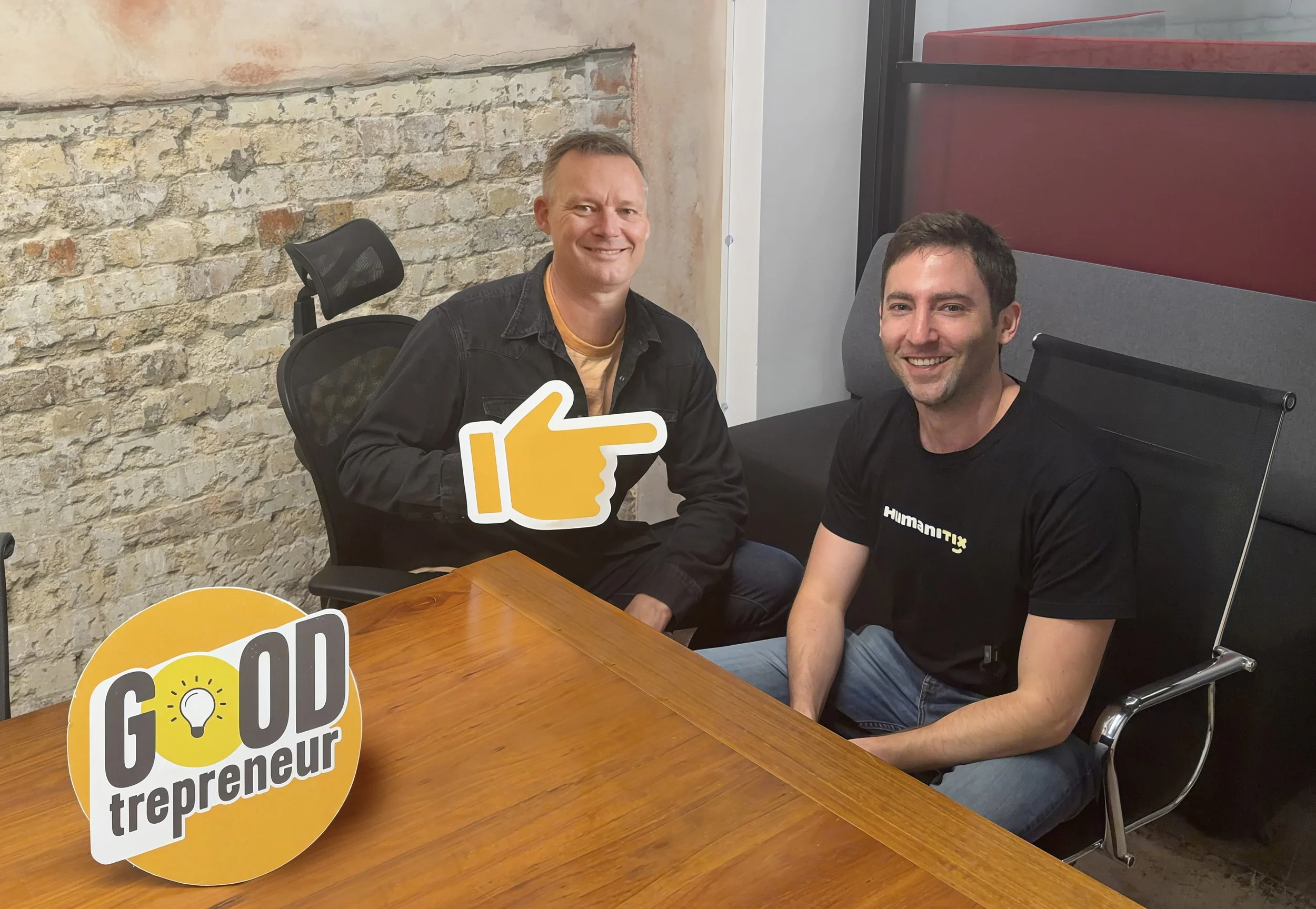
Recording in Humanitix’ Sydney office
Full Episode Transcript
Singers 0:00
I'm gonna change this world today. Make those bad things go away.
Ben 0:04
Alright. What is your favourite sport?
Josh Ross 0:08
Surfing but I'm not surfing much these days
Ben 0:10
And favourite song.
Josh Ross 0:12
Uh Here Comes the Sun. It's fresh to mind because it's what I'll listen to with my little girl every night.
Ben 0:19
So whether you're into opera, theatre or rock and roll, going to the circus or going to a show, one thing is for real: you've got to book a ticket. And it doesn't matter how often you go out, don't you always give a little grrr when you see the price of the ticket go up thanks to the booking fee. Especially when you know it's going to a global, almost monopoly that can charge pretty much whatever it likes. In 2016, Josh Ross and Adam McCurdie decided to do something about it by founding Humanitix. They still charge a booking fee, because hey, you've got to stone business, right? But it's less than the big guys, and 100% of profits go to charity. And with 50,000 tickets purchased through their platform every single day, there's a lot of good going on. Josh Rice is here today to tell us all about it. G'day, Josh.
Josh Ross 1:01
G'day, thanks for having us.
Ben 1:02
So, according to your website, high school mates Adam and Josh founded Humanitix after making a pact to escape the corporate world and do something different and meaningful with their careers. Do you want to tell me about this pact and how it came about?
Josh Ross 1:16
Yeah, sure. So um Adam and I became friends at uni and we did a bit of traveling together. We're lucky enough, like a lot of Aussie students do. We try and get somewhere else in the world for a while and learn some things. We were in Sri Lanka backpacking, and um just after their civil war had finished, and we were surfing, backpacking, and had some pretty cool experiences over there. And we were coming back. I was working at a hedge fund, he was going into management consulting. We both had like big dreams of what we wanted to do with our time and lives. And lucky enough to come from a place like Sydney where you can't starve to death. So, you know, you get a chance to chase your dreams without the downside being insane, like other parts of the world, if you're not responsible or things fail. And so we recognize that a lot of people don't chase their dreams because they get stuck in something that's good, like a job at a hedge fund where you're earning well. And then you meet someone and you have a family, and like it's very hard to move away from that, especially when everyone else around you is moving on with life with their mortgages, et cetera. And so we made a pact to each other that we'd hold each other accountable to chasing the dream. And that we anticipated one of the fears of not going out and to start something that you really believe in would be like it's a lonely path to do it alone. So we said we'll support each other, we won't let loneliness be a factor. Whatever it is, we didn't have the idea yet, we'll work as a team. And so that was kind of the agreement well ahead of us having the idea to take on ticketing giants.
Ben 2:30
So, what year is that? How far before you founded is that?
Josh Ross 2:33
Uh, we found it in 2016. I think that trip was 2000, well, it was just after the Civil War. So it must have been the summer of 2009 or 10.
Ben 2:40
Great. So really it took then a few years to come up with the idea, but you always knew you were going to do that together.
Josh Ross 2:46
Yeah, totally. And but we weren't hippies, so we didn't just like want to run off and start something with no skills or capital. So we so I ended up working at the hedge fund for what was supposed to be five years, but turned into seven years. And Adam went into management consulting for a few years and did some other interesting stuff. And then we kind of had the good idea, mid to late 20s.
Ben 3:03
Had the idea come up?
Josh Ross 3:05
Uh so Adam and I were like both fully in the corporate world at that point. Hedge funded. Yeah. Management consulting is the corporate world as it gets. Yeah, exactly. Adam had studied engineering and maths and me, finance and accounting. So it was like pretty black and white stuff. And we were both getting a bit disillusioned with like, hey, you know, we said we'd do something cool, but like here we are now 25, 26, 27, and we're still talking about it. And so we we started meeting up multiple times a week after work and going for long walks and chatting about ideas. And we kind of realised this was going to stay a PowerPoint presentation if one of us didn't go full time. And Adam just happened to be in a better position to go full time first. And he also had the better skill set for going first and building a tech platform. And we'd worked out that we wanted to do something in tech because we'd seen in the social enterprise landscape everything with bricks and mortar, um, like hard goods. We're like, well, tech's making more money changing the world than any other industry. Why don't we have do good as in that industry? And so we were trying to imagine what that could look like. And our initial idea was actually to try and take on Facebook. Um, we didn't spend any money on it, but we were just like, imagine if all the advertising revenue went to great charities in the world. The time like Facebook was doing 22 billion in advertising revenue. So imagine you got an email at the end of the year, hey Josh, the account generated three grand in advertising revenue, two grand of that's profit. Where do you want to donate it? He has a panel of great charities.
Ben 4:20
Have you tried sending that to Zuck
Josh Ross 4:22
Yeah, exactly. And then we knew that i thoughts would get slit because like there's a huge beast there with a great moat around their business. But um then Adam went full time exploring that idea um over a summer break. And out of that, he came up with ticketing as this idea, which was um still thinking about social media, but like ticketing had an immediate revenue stream. At the big end of town, it's it's like Facebook, there's a big moat. But at the small end of town, 10-person yoga workshops, small festivals, it's actually open game. If you can win on product and value proposition, you can totally take market share and get to cash flow break even really quickly. But with a social media platform, you're actually burning money for five, 10 years before you even start to turn a profit. And you can't really do that if it's philanthropically funded. You have to show results much quicker.
Ben 5:05
I hear the management consulting fees coming in very quickly.
Josh Ross 5:08
Well, this is a really nice combination of like I had the investment experience, he had the tech and consulting experience. So we could both ideate over concepts and work out an industry that was ripe. Like that's what we'd been trained to do between the two of us.
Ben 5:19
And neither of you had experience in like ticketing or music events.
Josh Ross 5:23
No, just uh being a punter going to music festivals and gigs.
Ben 5:26
Just experience being there.
Josh Ross 5:28
Yeah, just just having a good time.
Ben 5:30
That's really interesting. So you decided we want to do something that creates good in the world, but um, we're gonna find the industry that is so it was no particular passion for things.
Josh Ross 5:39
It's quite different to most founders who are like, I was pissed off with this experience because I'm a guitarist, and so I thought picks could be made out of this material. And no, it was like a top-down industry analysis thought piece. Yeah, very good.
Ben 5:53
Yeah, yeah, you are right, it is quite different. It's interesting. Different people come up with the ideas in completely different places. That's one of the things I've learned so far is there is no rhyme or reason for how people come up with it.
Josh Ross 6:03
Totally.
Ben 6:03
It's just a bit of everything. Um, that's awesome. So tell me about the platform. Obviously, you just mentioned before, you didn't go for the big festival, you're going for the smaller stuff, or you started there.
Josh Ross 6:14
Started there. Now we do. Now we do huge festivals.
Ben 6:15
Now you do the big stuff.
Josh Ross 6:16
But where it's still hard is like the stadiums.
Ben 6:18
That's very locked up. Right. Because it you hire the stadium, you get the ticket.
Josh Ross 6:23
Yeah, it's like locked in on a 10-year contract with Ticketmaster or something, or AXS in America. Um, and it's a duopoly effectively, where it's really hard to compete because they're in a network across America of venues. Yeah. And so it's very hard to compete at the big end of venues. But large festivals are often at a site that doesn't do anything with the rest of the year or something like that. It depends, but like there we can compete and we do win. So, like in Australia, a lot of the major festivals use us.
Ben 6:48
Yeah, and why would they? Why what's the obviously the money goes to charity, that's cool.
Josh Ross 6:53
But yeah, as a general, that doesn't seem to be enough to get something to and some of our peers that have done some really interesting market research, and they 90% of people will say they'll buy something because it's more ethical, but it's a fraction of a fraction that actually will when they're in the shopping aisle. And so um, is it true in events as well? You have to have the best software with the best service at the best price to win the majority of event organizers. I think everyone likes the profits go to charity, but that's not a selling point to win their business on. You will get some very ethically minded people giving you a go just on the back of it. They're like, I love the idea, I love the concept, I want to see that exist in the world, and they're phenomenal. And they're they were a lot of our early adopters and gave us the runs on the board to keep the concept alive, but you can't scale on that. Um, you actually have to be the best product to win.
Ben 7:39
What makes you the best product?
Josh Ross 7:40
Yeah. So quite lucky in that um we didn't have a lot of ticketing experience coming in when we started because we could bring a fresh perspective. And so I'll give you some examples of things that some of the big incumbents do that are just terrible for the event organizer. Like if you're using a ticketing platform that makes you create an account to buy a ticket, that is purely to your disadvantage as an event organizer and all for the ticketing platform's benefit because they're building their database by adding friction to checkout for your customer. And if you're buying six tickets on your mobile phone on the way home from work on a bus and suddenly you need to sign up and create an account, the chance that you don't complete that transaction or you go into a dead patch on internet and you maybe come back to do it later, but maybe you don't because we're humans and maybe you're applying to an Instagram ad that you saw to buy tickets for. So you're not going to go back to that thing. Yeah. And so, like the majors all make you do that. It's like card abandonments the biggest. Yeah. I mean, if you're an event or if you've worked and lived in the events industry, you know how hard it is to make money. Most don't. A lot of community-driven nonprofits themselves with committees that don't draw salaries. That's pretty much every folk festival in the world. Um, for example, they're struggling on very low margins. Some years they lose money and they don't have big capital reserves. You can't afford to lose a few percent of your sales, which is, you know, pure margin or an event because you've got all the fixed costs already spent. And so, like, that's one really obvious thing. We're like, no, we're not gonna be pricks. Like, you don't have to join our database and have a Humanitix account to check out. That's complete rubbish. We're not gonna make anyone do that. And so there's lots of things within the ticketing industry that can be done better. That and we have a completely modern architecture. And so, like our page load times, our features, it's like way better than some of the legacy ticketing platforms out there. It's like we joke we put the human back in ticketing, but you can go on trustpilot or Google, you'll see we're uh we're like a 4.8, 4.9 out of five stars, which is unheard of in the ticketing industry. Um, because when you apply for a job at Humanitix, you're generally aligned with the mission. And so if you're customer service at one of the major ticketing giants, you're at the bottom of a big corporate structure and you are a number on a spreadsheet. They won't say that, but everyone knows it. And you hear it when you're on the phone to their customer service staff. Where at Humanitix, you're a valued team member, you give an agency to push change through the organization. But most importantly, you're proud of what you do. You're helping the build this beautiful organization that's giving the gift of education or health to so many disenfranchised people. And uh the impact per employee at Humanitix is huge. It's hundreds of thousands of dollars every year. And so they have a lot of dignity as they should. And we um we really look after them. So when you call Humanitix for help, you get someone who's very well educated, who's very motivated to help you. And I don't think our competitors come close on that front. And so we get a lot of virality of word of mouth because our competitors are cutting their customer service operation and replacing it with bots and doing as much of that as possible. And even then, when it is a human, it's like, you know, it's a corporate experience. Is that where the name came from? Ironically, not. Um, humanitarians was more a play on the humanitarian giving that we plan to do. We thought we'd have competitive advantages and disadvantages with attracting good people because the reality is like we're building really good technology, you need really good product and engineering talent. And therefore you're competing with the biggest tech companies in the world. And we don't have equity to give our staff. So that would be hard. But then the intrinsic motivation of doing something good for the world for the right employee is like, I think, more motivating than uh driving a fast car. So yeah, there's been wins and losses on that front. The customer service thing, we didn't actually anticipate that being a huge competitive advantage as we scale.
Ben 11:01
So that's interesting. So really you've looked at this industry and gone big monopolies really do have a habit of leaving opportunity to innovate them on the table, don't they? I mean, look at cab charge and taxis and whatever. But but so you found number one, just by making it um frictionless for the purchase, that's of benefit to both sides, right? As the customer, it's a much more enjoyable experience. But also, as you say, for the ticket seller, they don't lose that abandoned car thing. Yeah. But then customer service, which I imagine works also for both sides of the market too, makes it easy if you want to put your event on the platform and you need a bit of help, but also easy if you're a person trying to buy a ticket. So just bringing people back into it, funny enough, a digital platform.
Josh Ross 11:40
Totally, exactly. And so any client of any size can jump on a call with our team to help for help. And if it's complicated, we'll jump on a screen share session with them. Um, other ticketing platforms, you have to have huge tiered pricing structures to get that type of support. Um and so, yeah, a lot of our clients are the, you know, 100-person Rotary Club, uh, 10-person yoga workshop, all the way up to 100,000 person music festivals. And obviously, we service the big festivals more intensely because they need it and they deserve it. But um, we don't forget the small ones.
Ben 12:08
There's certain um I've used your platform dozens of times. Just anything in this sort of do good world tends to use Humanitix. Obviously, that's probably a little core audience where it all begins. Absolutely. So to me, there seems to be a huge brand benefit as well. Like it says something about your festival or your band or your organization if you choose Humanitix, right? This says we actually care, we're thinking about our entire experience and how we can do better.
Josh Ross 12:33
Totally. That's a big part of the strategy is to improve the brand equity of our client. And in the ethics sustainability business world, usually doing good costs more. It's a tax effectively on the business. And it might be worth paying that tax because it's really important for the world. But this we did think of before going with Humanitix is that um we could actually make doing a good business decision. So if you switch from our major competitors like Live Nation or Eventbrite or Moshtics or OzTix, typically you save a lot on the fees and you get to look good, which is just good business. Whether you actually have good intention for the world or not, or it's just a nice to have, it shouldn't matter if we're nailing the value proposition, which is to us our secret source of making this scale so quickly. We're not relying on people's good intentions. Those matter too, but like you don't want to be in a business position where you rely on that because it's not enough, I don't think, to get mass adoption. It's people are too distracted, they're not gonna lean in.
Ben 13:27
Yeah, totally. And uh it's interesting, isn't it? I mean, one of my discoveries has been it seems like the do good is great for getting the word out there. It wins your awards, it gets your media, it gets people to go, what about? Gets no sales, gets no one over the line. You've got to push it over the line with and it's cheaper. Is that what you find?
Josh Ross 13:44
And yeah, yeah, totally. Or we've got this feature you need that you can't do with other platforms. So, like we launched ethical resale. A big problem for festivals in Australia is scalping, and also they can't control the resale market. Um, and there's a lot of scams that goes on with it. And also it kills their primary sales if they haven't sold out. If suddenly people are dumping tickets on the secondary market at a fraction of the price. There's a whole range of elements. And then there's third-party tools you can use, but they take 20% of the ticket price. 20%. Solid. And it's like pretty basic technology. So we we launched Humanitix Resale, which um caps the ticket price at the original price. The event organizer has control over when it's public. The fees are just the booking fees normal for the event. And there's no fraud if you use it because it refunds the original buyer at the time of the new purchase, as opposed to being like blind on the original purpose, which a third party would be. It's so simple.
Ben 14:35
So simple. Why didn't the big guys do it?
Josh Ross 14:36
It's not in their interest. They get to double, triple, dip on the secondary market. So if you like a lot of the big primary ticketing platforms, own secondary ticketing platforms, but they actually have a negative, they have a perverse incentive structure where they want the ticket to change hands multiple times because they get to clip the ticket multiple times, often at much higher fees on them multiple times. So, you know, sell it for $100 to the sculper, the sculper sends it $500. You're making 5% on that or 10% on that each time. Yeah. It's like a brokerage business. So uh where ours is like a we're not just not looking at it from that angle. We actually want to support the arts and community and not be these dirty middlemen.
Ben 15:12
It's interesting, isn't it? Because you can see the temptation of a quick buck causes things in this world to be less good than they should be for the end user or for the general public.
Josh Ross 15:22
Yeah, totally.
Ben 15:23
And but I can see it, it must be hard for those companies to sit there and go, Oh, we've got to give up that money now that we've got our hands in this kind of grubby money. But it it offers this great opportunity for businesses like yours to go, no, we're gonna be ethical from the start. I think do you I think starting with ethics matters, doesn't it? It's really hard to build them in later.
Josh Ross 15:41
And governance matters, like we're structured as a non-profit with no shareholders, so we can make these decisions without our board members being like, well, we have a fiduciary duty to get our shareholders a few more Lamborghinis. But uh it's interesting philosophically too, because if all the roads in Sydney were privately owned by one operator, they'd obviously charge through the roof and it would be a terrible thing for society. Yeah, trying to happen, right? But um, but at least that's restricted to a few roads. But the where I was going with that is like a ticketing platform are the roads into the arts. And so we know we live in a society where artists are poor and don't make enough. Um, we know we live in a society where everyone's under cost of living pressures and with less money to go support the arts. And so if we have the critical infrastructure to access the arts being monopolized, or that those for-profit entities dominating that and charging excessive economic rents, that's a terrible outcome for the arts. And so we generally think ticketing should be nonprofit. And so, yeah, it's not healthy for society when it's not.
Ben 16:40
It's a constant theme, isn't it? What's good for society is not always good for the individuals that control things and trying to get that balance is really hard, which actually brings me to question for you because have you therefore made a very personal choice here? If you'd have started something that had none of this governance and ethics behind it, you just went for the same, you know, you could have just done the frictionless purchase, you could have just done the lower fees, you could have just done the better customer service and not given a charity, and you'd probably have a couple of Lamborghinis.
Josh Ross 17:08
Yeah, totally. You know, it's not a mortgage, yeah. Yeah, that's right. It is a bit of a crazy mind thing where like we're giving away now $20 million to charity, and like me and my co-founder, we'd probably own 30% each of the company if we hadn't done this model, which means I'd be mortgage free and like without a worry for my children and all that.
Ben 17:24
Tell me about that as a decision and as a person. I mean, because I've always believed, you know, really if we want the world we want, the people making it better should be the ones that are sort of better off in it within reason. We probably don't need any billionaires or trillionaires. But do you find that, you know, is your mindset? No, there's a a point of enough. And as long as I can reach enough, I prefer as a human to be doing something I believe in, and that's a greater payback for you. How do you know what's the balance in your mind? How does this work for you?
Josh Ross 17:51
Yeah, for me personally, like um to me, uh, too much money has a higher risk of screwing up my kids. And so I'd rather have like enough of financial security, enough to give them a good education, enough for some contingencies and potentially to help them with housing, because that's a huge issue for society. And I don't want my kids to be unable to have as many kids as they want because of financial reasons. But I so don't want to spoil them. So there's those balances. But um, you know, me and Adam earn reasonably good salaries now. It's not market rate for what we do. There's no equity, which is really where you make money because of the tax code. But like we're earning enough that we can actually have it all from our perspective because we don't have expensive tastes, which is great. So I don't feel sorry for myself for having chosen this path at all from a financial perspective. We're also lucky. We come from Sydney, both come from nice families. It's not that we didn't have to work, we do have to work, we have to earn a salary, we've got mortgages, but yeah, we're not up against it. We're very privileged from that perspective. But the other thing is, you know, what I say to entrepreneurs who are starting things is like you don't have to do the humanitarics model. Like, who gives a crap? Those founders. It's 50%. So they're doing really well. They've got funding, they've got equity. I presume they don't have mortgages. I don't know. And they really care about what they're doing and they're making a big impact. You know, we could have done the same. I don't think any clients would or wouldn't use us if it was 100 or 50%. Most don't even know that we're giving 100% or that we're a charity. Yeah, most don't know. Most are just, oh yeah, something good happens with the fee. And to be honest, we don't market ourselves aggressively as a charity because we think people have a negative connotation with a charity providing a service, and we didn't want to get marked down as like, uh, this is gonna be the shabby old, poor branded, like kind of works ticketing platform because it's run by a charity. You go to our website, like you can see if you look for it. But like we want it to look like a modern slick tech company that does good in the world, as opposed to like an old school charity that's run by hippies that probably doesn't have very good technology.
Ben 19:41
That's so interesting. You're not the first person to have that point of view either, actually.
Josh Ross 19:45
We saw it when we started. Like um, a bunch of uh competitors used to email some of our clients, be like, Oh, you shouldn't trust them, they're a charity, they're not gonna be able to do your complex ticket.
Ben 19:53
Really?
Josh Ross 19:53
Yeah, yeah.
Ben 19:53
Oh my goodness, that is like so
Josh Ross 19:55
yeah. And then as we got bigger, the email changed to like, oh, but are they really a charity? Once our tech was good. It's like super dodgy shit. Politics, yeah. It's like try anything. Totally throw as much mud as you can see what it does.
Ben 20:10
But they probably all they probably did is um serve to make people go have a look at you.
Josh Ross 20:13
Well, yeah, people forwarded it to us, and they were like, just so you know, these pricks are saying this, but it don't worry, we're we're smart enough to see through it.
Ben 20:19
It's horrible, isn't it? I mean, I try to believe the world's not evil, but sometimes there's some bits that definitely are. Um I want to go back to what you said though, because that mindset is fantastic. I mean, look, if we're perfectly honest about it, you know, in sustainability or you know, a future of this many people on the planet has to come with everybody recognizing what's truly of value in this world and and not all seeking the Lamborghini, right?
Josh Ross 20:42
Yeah, I don't have a problem with someone seeking a Lamborghini. I just think um for me it's not what I want. Like, I I don't have a problem against people becoming billionaires. What I let me let me let me caveat that. Let me caveat that. Like it depends on what they do with it. And so, you know, but also at this, like, you know, if they want to create centers of excellence and push society forward in areas of interest to them that are actually, I think, good for the world, all power to them, and you actually need to accumulate a lot of capital to do that. But then, you know, so much of it just becomes gross, consumeristic, materialistic stuff. Like, let's be honest, we live in different societies around the world are more about Louis Vuitton handbags than anything else. So that to me personally is a bit gross. But yeah.
Ben 21:20
I like what you say there, because I think there is an uncomfortable thing in people that says, oh, you can't, you know, money and doing good shouldn't be near each other. Whereas what you're saying is money is not the thing. Money is the fuel. Yeah, totally. Really, and as long as you do something worthwhile with it, then it's actually really good fuel, right?
Josh Ross 21:35
Also, if someone wants to drive a Lamborghini, but they're also like helping radically change the way we create energy for the world. Or like, I don't care what they do with because once you're a billionaire, you can't really spend that much on your personal luxuries because they're dropping the ocean. Like, I care much about the substance of what they're doing with the time. If driving a Lamborghini is what gives them energy and they're dedicating their life to like it advancing humanity in a meaningful way.
Ben 21:56
I read a lovely quote over the weekend. It was in a story that said, um Don't feel guilty about your privilege. Feel guilty if you don't do something good with it. Yeah.
Josh Ross 22:04
Yeah, totally, totally, totally. Yeah, I think it's I think on the other side of society, it's like this sick obsession with like demonizing success or wealth, even. Like that's not smart.
Ben 22:14
Yeah. I mean, it's been pointed out too that a lot of the wealthy in the past, you know, opened libraries in every, you know, locality across the country or those sorts of things.
Josh Ross 22:24
Yeah.
Ben 22:24
This generation of um billionaires seems to all want to go to the moon. Yeah.
Josh Ross 22:29
But I don't know. I mean, uh, in the a lot of entrepreneurs, like you look at the founders of Canva, like they wouldn't have been able to build that company as a charity. And they're now doing so they're like they've pledged that almost all of it to charity. They're putting their money where their mouth is with huge grants to give directly. They wouldn't be able to do that if they weren't billionaires. Go those types of billionaires. Like, and if they want to drive a nice car, good for them. Like, I don't really mind that. That's not a problem. I don't want to jump on the like conventional bandwagon of demonizing success and wealth. That's um No, but yeah, I agree with you.
Ben 23:00
I mean, it's really interesting because you're starting to see this through the whole series of everyone I've talked to. It's almost this a more conscious form of capitalism. I know that's been used before those terms. But um, where you go, let's stop thinking about money as the bad bit and you know, charity as the good bit, and go, well, profit fills purpose. If you can make money doing good, you can grow the good, right? Totally, totally. And that's if we're ever gonna get where we need to go, it's only by changing the everyday of business, how we interact with each other that we're gonna get there, really. Yeah, totally. Can you see a um bunch of other industries ripe for this in your management consulting moments? With it like a top five or anything.
Josh Ross 23:36
Yeah, I think uh it's hard where it's people businesses, because um, then your ability to attract the best talent is gonna be hard. But where it's like a commodity, like ticketing to us, yes, there's complex software behind it, but it's not rocket science. Where there's not a huge moat, like a network effect like what you have in social media, and it's a somewhat scalable commoditized solution. I think this model can work really well. We've had thoughts about like other industries you could disrupt with this type of model. Like imagine your car insurance, for example. The profit of that premium could go to a good cause. You don't really care about the brand behind it. You care, I mean, you do, you want to know that they're financially sustainable and responsible. But the policy isn't a commodity as long as it gives you what you need. It's not like you're buying something where the the quality of the ingredients there was one in UK called Lemonade that did exactly that.
Ben 24:21
They did it for home insurance. Yeah, actually. It was interesting because what they to your point, where you found a niche in the market with or started with the niche in the market of smaller events, they started with um people renting.
Josh Ross 24:32
Yeah.
Ben 24:33
Because it was they found that just weren't wasn't a very well-served market and grew it from there. So interesting. It's interesting though, that differentiation, you're going okay, the commodity product is available, which is a little bit like who gives a crap as you say. Yes, yeah. But then you also mentioned before, you know, where the quality of the ingredients happens. That seems to be the other side of um these kind of companies operating this spaces. You can also differentiate through quality as well. Yeah, you see it in skincare and things like that. I mean, think about um Body Shop, you know, just to prove none of this is new back in the 70s against animal testing. And so our ingredients don't kill animals. That was sort of, I know it's not quite the quality ingredient, but it was about the ingredient that goes in. So it does seem to be able to be differentiated both ways. Either you go commodity plus better or you go quality. Yeah, totally. I guess the beauty of a commodity is you get the opportunity to uh play with price, as you've said.
Josh Ross 25:22
Yeah, yeah, totally. Buy commodity, not necessarily a true commodity in the sense of like it's commoditized, but just in the sense of it's um, you know, like if you were to try and take on car manufacturers with this type of model, it's like that's super capital intensive. To build a better car than Porsche, it's like good luck if you don't have investors. Like, you know, it's a long time, but like to make an underwear brand where the underwear are quality. It's like that's not rocket science. So like ticketing software is complicated, but it's not like insane rocket science where a company has insurmountable competitive advantage in the way they built a feature. It's just not like that.
Ben 25:55
What were the harder barriers to get through? I mean, obviously, building software takes time. Was that ultimately just a question of planning it and figuring it through? Or was it harder than you thought, easier than you thought? What were the hard bits?
Josh Ross 26:05
We're really lucky, Adam's my co-founder, because um his consulting was in tech. And so uh I would have screwed up the Wildingway ticketing platform many times over and we wouldn't be where we are if I was trying to direct that. And our CTO and the engineering team that joined us have been fantastic. It's yeah, really hard to build really good software that's customer centric in any industry. But um get the right. Yeah, I don't want to underplay how hard that was because I'm just very lucky that we've got some very gifted people in the team that are good at that.
Ben 26:34
Okay, so yeah, so basically by getting the right people, that made what could have been a very hard job, at least only a hard job.
Josh Ross 26:40
Yeah, totally.
Ben 26:41
And and what was easier than expected along the way? Um Did you find once you put the idea out there, people would go, I'll be in, I'll make that happen. I mean, you got investment too. Was that hard to do?
Josh Ross 26:52
Yeah, incredibly hard to do. Me and Adam co-founded the first two years mostly. We had a few high net worth individuals chip in 10, 20k here and there. But like we were banking on some big philanthropists coming in for like million dollar checks if we could show runs on the board and that this was working and that, you know, our pitch to them was hey, with a few million dollars of philanthropic capital, we're gonna build something that spits off tens of millions every year. It'll be the best philanthropic return in your portfolio. Like we're gonna replicate technology returns for philanthropy, and technology returns are the best in the market. So that was the pitch. And then we kind of um, because we didn't have any equity, we kept going into these foundation meetings where they're like, look, we love what you're doing, but you don't fit our foundation's mandate because we care, you know, we're here to fund domestic violence shelters in your ticketing platform, or we're here to fund the environment in your ticketing platform. We don't fund intermediaries. Um, and they usually don't fund intermediaries because intermediaries usually just clip the ticket and give less to the end cause. But yeah, so we didn't fit anyone's mandates as a from a philanthropic perspective. So it was really hard. And the idea almost died because me and Adam weren't millionaires. We couldn't bankroll it to cash flow break even ourselves. And we kept having these meetings where people would be like, if you convert to a for-profit and give some of it to charity, we'll fund you tomorrow. Like we can see because you're getting runs on the board, like your revenue scaling quickly, better than you'd expect for a small startup. You know, you've bootstrapped this thing, you've got a good technology that's obviously winning clients, but it's just not what our foundation set up for.
Ben 28:14
So why would they be interested if it was only part to charity?
Josh Ross 28:18
What's the Oh, because the if you're if okay, so say you're like a family office, yeah. You've got two buckets of money typically, like the do good bucket and the make more money bucket. The make more money bucket is just there to chase making more money. There might be some rules around it, but like the best idea walks through the door to make money. You're not gonna be like, sorry, mate, we don't um, yeah, that's uh that's not how we like to make money. We think you're gonna make shitloads of money, but like, yeah, it's just not the flavor of money we like to make. Um in fact, they'll do the opposite. They'll be like, we'll invest. We wanna, how much are you raising? Cool, we want all of it. There's greed. They want to lock down the cap table. The venture capital firm doesn't want you to go meet with all the other venture capital firms if they think you're a winner. They want as much as they can get. Well, in philanthropy, it's completely different. Like you have, you do care about the flavor. You're not just from an up um perspective, I want to do the most good in the world. You're typically from the perspective of this is what I care about. This is the niche area I want to develop expertise in and have impact in. And there's so much noise out there that I'm just gonna stick to my knitting on this. Makes sense to a degree. Just it puts our model at a disadvantage. And so, you know, there were no foundations set up to disrupt ticketing, obviously. Um, and so we just kept falling out of scope. So we got lucky in 2018 because uh Google ran an impact challenge that's a global competition for tech ideas to change the world with a million dollars in prize money um as a grant, and we won that in 2018. And if we and the same year at Lassie and through their foundation, they fund innovative stuff. And so their mandate was a bit more flexible than your traditional corporate mandate. And so we got funding from them. And if we didn't get that support, Humanitix would have converted into a who gives a crap type model.
Ben 29:57
Interesting. So you basically found the tech companies were prepared to support tech that was there.
Josh Ross 30:01
Yeah, and a bit of lucky right place, right time, because there's very undeveloped markets for tech philanthropy. There's not much going on. Interesting.
Ben 30:08
You'd think there would be, wouldn't you, given there's so much money in it?
Josh Ross 30:11
Oh, there's like 1500k grants here and there. But uh the problem with philanthropy and social enterprise is like everyone's happy to seed something. No one's happy to follow on. So there's no so like in for-profit industries, like you get your seed capital and there's bigger markets for the follow-on capital of your ideas working. Philanthropy prints the opposite.
Ben 30:29
Yeah, no one wants to write big checks. They want to kick everyone off and then make them self-funding from there.
Josh Ross 30:34
Yeah, it's just um, I don't know, there's a bunch of like cognitive barriers.
Ben 30:39
That is strange, isn't it? Given the, you know, the the standard kind of startup funding model is built on seed series A, series B. Like it's it's recognized that a company will need bigger and bigger cash injections as they grow. Yet in philanthropy, the idea is no, we'll give you a little bit, and that's meant to be it. It's like saying, well, water the plant at the start and then hope it rains. You know.
Josh Ross 31:00
I mean, it's a big problem for big conventional charities because like you do you like say you become the best in the world at feeding the homeless in Australia, and now you go from like a half a million dollar budget with two big donors to like 10 or 20 million dollar budget. Well, now you got to replace that budget every year. And so your CEO goes from feeding the homeless to having to spend 90% of our time on fundraising or his time on fundraising, which means it's a massive challenge. Cause like in a normal business, the CEO has to spend time managing stakeholders, but you want them running the business, doing what they do best. And so it's a it's a problem with charities that's inherent to the structure of how they fund themselves.
Ben 31:33
Yeah, there's always a very big hole in the bucket, isn't there?
Josh Ross 31:36
Yeah. And the more good you do in the world, the bigger the bucket becomes, unless you're a social enterprise model that actually becomes profitable.
Ben 31:42
Yeah, there's a lot to be said for the social enterprise model, isn't it? Because it's financial sustainability, really, isn't it? Yeah. Think of it that way.
Josh Ross 31:48
But so few get there. Like it's a graveyard in Australia at the moment. A lot of the social enterprises out there are really struggling. Yeah, but um, yeah, we speak to people and it's like it's quite depressing. We're luckily in an exception.
Ben 31:59
Yeah. Who else is managing to pull it off that you know?
Josh Ross 32:02
Um, I think who gives a craft is one of the best examples. I haven't caught up with them for about a year, but I think they've given close to $20 million to charity since starting out. They raised capital really effectively, I think sometime around COVID and have grown into America, the UK, and Australia. And a pretty well-known brand.
Ben 32:18
Are you beyond Australia?
Josh Ross 32:19
Yeah, yeah. We've got um a very fast-growing team in Colorado. We've been there for five years. Uh, we launched in Edinburgh last year. It's actually started fantastically well. And um in 2018, we went into New Zealand, and that's pretty good as well.
Ben 32:31
Interesting. Yeah. Directed New America verse, then off to Scotland and off then.
Josh Ross 32:34
Oh, sorry, we did New Zealand and then America, then the UK. Got it. That makes sense. Yeah, so Scotland services the UK.
Ben 32:39
Is it once you've got a platform, which is obviously international, is the move into a new market easy or is it just come with a whole new world of pain that because the setup's different?
Josh Ross 32:49
A bit of both. So, like uh every new market has its complexities and labor laws and taxes and compliance and all that stuff. And so it does become more of a headache and time zones, you're suddenly managing teams in different regions, and that encroaches a lot on your life, um, to be honest as a CEO. But being software, it is much easier than a traditional business. There's a bit of work to be done with infrastructure and currencies and taxes, but broadly speaking, it's not a huge lift to switch on Humanitix in a new market unless it's a completely different language and all that kind of stuff. But English speaking, it's pretty easy. Interesting.
Ben 33:23
So you're gonna keep going internationally? Is it?
Josh Ross 33:25
Yeah, we're currently working on it. Like we're already live in Canada and Europe, but we don't have Humanitix charities set up in those regions. We're working on that right now. So Humanitix is a charity in Australia, New Zealand, America, and the UK now. And you've got to set up a local charity to spin up the operation. You can license the software for free to it, but like you need to employ people there in a local charity. So it's it like adds a whole bunch of compliance.
Ben 33:45
Yeah, bet it has charities that have huge compliance, don't they?
Josh Ross 33:48
Yeah. And it slows you down a bit. So we can't just go launch a team in Germany or something. We have to spend six to twelve months working with lawyers and charity regulators. There's not many people to copy because no one's really scaled a tech charity in the world that we're aware of. Yeah.
Ben 34:01
So yeah, isn't it funny that if you just wanted to do a company, it'd be so much easier. As soon as you want to do something good for the world. That's a whole bunch harder. Tell me about the charity bit. So 100% of money goes to charity. You've got the ball of money at the, you know, let's say I'm sure it happens all year, but let's say at the end of the year, how does the transfer go to charity? How did it get chosen? What's the model? How does all that work?
Josh Ross 34:23
So um we generate our profit and our board works out how much of that we want to pay out in the current year versus how much we're gonna pay out over the next couple of years. And within that consideration, is like, well, we've got to fund the Humanitix growth internationally because that's a strategy. And we think we can maximize our impact over time by having Humanitix success so in America, Canada, UK, et cetera. Our ambition is for it to be giving hundreds of millions of dollars a year in five or 10 years' time, which if we can replicate Australia and New Zealand's success, it should be doing. And so it's just a board decision over how much like it all goes to charity, but how much goes to third-party charities right now versus how much we retain in our foundation effectively to give out in future years. Because another thing you want to do is give multi-year grants to your partners. And to do that, you need to have a foundation effectively so that you know you've got the money to give them for the second year.
Ben 35:09
Yeah, keep watering that plant, right?
Josh Ross 35:11
And so um, so yeah, that's kind of how it works. We've got a board of directors. They're all volunteers, but they're pretty damn engaged and they meet multiple times a year to work with us on these types of things.
Ben 35:21
And how do you choose which charities you give to?
Josh Ross 35:23
Yeah, so we partner with some really good think tanks who operate in the areas that we care about, which are global poverty, health, education. So a big partner is the Life You Can Save, which was founded by the philosopher Peter Singer. He writes a lot of different stuff, some of it's pretty controversial. But his writings on um extreme poverty, I don't think of particularly controversial. It's effectively saying that um, you know, we live in a world where people are starving to death. They're on one meal a day, they can't provide a home to their children, their children are stunted and anemic and maybe dying from malaria. What are the most cost-effective ways we can alleviate that suffering? He writes about the philosophy and the morality of the obligation to do that if you have more than enough. And so he's got this think tank, which has an amazing team, which spend all their time trying to work out what are those best projects to fund. And we piggyback off a lot of their research and fund projects that they suggest. And then we've also got some internal staff giving programs. So one of the benefits of working for Humanitix is it scales, but like once you've been with us for two years, you get 10 grand a year to donate to a charity of your choice. There's parameters, so you can't go and give it to something super controversial or that doesn't align with what the change you want to create in the world. That's actually adding up now. It's about half a million dollars a year that the staff give to projects of their choice. And so, you know, there's like really cool scenarios that people are giving to like food banks that they volunteer at and all different domestic violence shelters they might have a connection with, different programs that we agree are good for the world. Would they necessarily be the most effective thing in the world to alleviate extreme suffering? Maybe not, but they're directionally really good and it empowers the staff to engage and learn and they have to present internally on why they chose that project. And it's like a, you know, they don't get equity, but they get that, which is pretty awesome. And our intention is to keep scaling that as we grow and kind of work out a new way of building a tech company. I love that. It's not match giving. They don't have to donate from their salary. It's like, no, you helped us generate this profit. You get a say in where it goes.
Ben 37:13
Well, as a charity, it's kind of the equivalent of an employee um issues. Yeah, equity scheme, isn't it? Isn't it? Is you get equity, but you got to give it away. It's really cool. It's like a lot of things.
Josh Ross 37:23
When he's giving 10 grand to charity here, personally. Like honestly, like it's a fraction of a fraction of that. And and we've got like uh 23-year-old customer service staff getting to call up their a charity of their choice and be like, hey, yeah, my name's Josh. I'm giving you 10 grand this year. And it's a beautiful experience for them to get to have. And you know, you work here for five years and you've probably donated more to charity than you ever would have in your life. I mean, realistically, people are donating hundreds of dollars to charity a year.
Ben 37:46
Yeah. Yeah. 30 bucks a month seems to be the request from most charities.
Josh Ross 37:50
Totally. And fair enough. Like everyone's, you know, got things to keep up with and all that. So it's a very powerful tool.
Ben 37:55
That's an amazing tool. I'm amazed more foundations don't use that because I mean, as you say, it's got a feel-good factor, which is great. I mean, that must be one of the greatest phone calls, the greatest phone call you make all year. Hi, I'd like to give you 10 grand. You imagine the uh mic drop on the other end. But also to your point, it makes them learn. Because if you're giving away 10 grand, you're going to spend the time to actually figure out am I giving to the right place? It's different to I'll give a hundred bucks, ah yeah, I'll give it to guide dogs, they're cute or whatever.
Josh Ross 38:20
It's like you have to justify it to the team because you're gonna have to get up and talk about it. Oh, that must be a cool. So that that's the that's the hidden element that makes it a thoughtful process. Because if you don't have that, then some people will just willingly give it away, which is not the purpose.
Ben 38:34
Is it a three-minute pitch? Have you got some sort of structure around that? A couple of videos.
Josh Ross 38:37
It's not time confined, but there is a like an afternoon in every office where like it's giving day, and we took we actually had this spoof where we used to call it filthy Friday philanthropists, where we'd all suit up and have glasses of wine. Oh, that's okay. That's too funny. That wasn't the day we did the presentations. It was just the day that we announced to the company how much we're given that year. But it was it was a very funny parody where we'd laugh at ourselves internally. But um, yeah.
Ben 39:05
Sound that culture seems like a very big party of success.
Josh Ross 39:08
Yeah, absolutely. And uh because another interesting part is because there's no exit, like we don't have equity to sell. Um, we've been very mindful not to employ people that toxic to the culture, but are really good at their job. Because, you know, if I was selling in two years' time and the head of growth was gonna 3x our business, but he was shit to work for and like a mean person or whatever, you might put up with that because, you know, he's gonna 3x your exit, which might be tens of millions of dollars. But if you're never exiting and you've got to live with this people and you're gonna live with a team of people, like you're not gonna necessarily trade culture for performance. And so we hire it more slowly and like are very religious about what we will and won't tolerate internally.
Ben 39:46
What's the number one thing you hire when you're meeting someone? What's the one number one thing you're looking for?
Josh Ross 39:51
We've got it like a checklist, but uh, I'd say like uh genuine curiosity is a big one we look for. Like if you're an engineer and you apply for a role here and like we ask you, oh, what are you working on outside of work? And you don't do anything related to engineering, it's like it's a good tell that like you're not passionate about engineering. It's just a job. So it like it doesn't have to be engineering that you do outside. Like if you're an engineer, that's just one example. But like it's really one people who are curious about their trade as well as a mission aligned, but it's more about like having creative, interesting people that are open-minded. We don't want this to be a nine to five, like, yeah, it's where I go to end my living, but that's it. Like we want people to be contributing to what we're doing for the world. We want people to be leaning in and becoming passionate about the change we're trying to create affect in the world.
Ben 40:32
I love that answer. Yeah. Curious, it's funny as I've I've realized that two things seem to keep people young. One is staying f healthy, which is a physical thing, but mentally, curiosity. Yeah. It's funny never shutting off to the changes in the world and always being curious seems to be the defining factor of people I've watched get older who I've kind of want to be like. Yeah. And you've just nailed it as a key hiring point.
Josh Ross 40:54
Yeah. That's very good. For me at Adam Dav Energy, we have to be with inspiring, interesting people. Yeah. And that's the truth of the team. Like if you're working for a manager who's not inspiring and interesting and creative.
Ben 41:03
What a truth. Who wants to?
Josh Ross 41:04
Yeah, like what a difference to your the biggest thing you do every week. So you get to spend more time at work on work than you do with your family and friends. So if work isn't a place that's inspiring, then your life is uninspired. Or a big chunk of it is. Sorry. I'll take that back.
Ben 41:16
Like um, you'd be getting ready to leave pretty early when you totally.
Josh Ross 41:21
So like it's not, yeah, it's not enough to just um do the thing. You gotta actually make this an environment that's awesome to be in.
Ben 41:28
How many people have you got?
Josh Ross 41:29
Uh about 80 globally.
Ben 41:30
Yeah, it's quite a lot, isn't it? It's a lot to manage.
Josh Ross 41:33
Yeah, it is. It's like it's we're first-time founders, so it's you know, every stage is like, whoa, this is crazy. But um, but yeah, we also appreciate there's a lot of tech companies out there with thousands, but we don't really thirst for that. That doesn't look fun.
Ben 41:46
No, well, you guys are doing what, 50,000 tickets a day. That's a lot.
Josh Ross 41:49
Yeah, we're not the largest Australian ticketing platform, which is pretty cool. Really? Yep, yeah. So Live Nation's obviously bigger than us, but they're not Australian. Gotcha, gotcha. So Moshtics, Oz Tix, all those. Well, Moshtics sold to Live Nation, but Moshtics do two to three million tickets a year. We do close to 20. Wow, you guys really are nailing it. We're no longer this cute charity idea.
Ben 42:06
We're no longer you run events.
Josh Ross 42:08
We're still use Humanitix. Thanks. No, it's really cool. We're now like um the biggest marketplace for events in Australia. If you want to sell more tickets and get more eyeballs on your events, you're probably smartest to list your events on Humanitix. And the icing on the cake is the impact. But like it's a good commercial decision to use us.
Ben 42:25
It's a great commercial concern. Um, I'm gonna let you go soon because you've got you know, you've got an enormous company to run. But um tell me very quickly, you're also an activist investor.
Josh Ross 42:35
I have once been in my life, but you're right. No, but it was a it was a fun chapter. And like I would be again if a good opportunity came up, but like it's not my pref. So I worked in a hedge fund, so I understand investing. Um, that's what I did for seven years, long short equities. It was a very successful Sydney hedge fund when I was there. So, you want me to share what happened? Sure. Yeah, it's an interesting one. So um, Australia has a company called AGL. Most people have heard of it. It's one of the biggest energy retailers in the country and generators. That company represents about 8% of the emissions of Australia. But they're, you know, a huge generator of electricity. Of course. And a lot of that's wrapped up in their coal plants, effectively, pumping out energy in Victoria and a few other anyway. I won't go too much into their business model. But long story short, I was at a Room to Read event, which is an education charity for girls' literacy that we fund. And one of the founders of Atlassian, Mike Cannon Brooks, who I barely know by the way, like I've maybe had one or two words to him at an event in my life. He gave a speech there. And one of the things he talked about was AGL and how it's a huge opportunity to radically improve Australia's carbon footprint in a really smart way with renewables coming in in an affordable way that he's gone deep on it and he's done the numbers and he thinks this is like a great thing for consumers, society, and the environment, and a really important case study for the world. And the board of AGL was trying to split up the coal assets in the energy retail business to make them distinct and separately listed. And once you separately listed the coal assets as just the coal assets and they weren't integrated with the retailer, it'd be pretty. Much impossible to economically make sense of shutting them down and replacing with renewables. You just sweat them until they they weren't making money anymore. And so that was going to be like a terrible thing for the world, in my opinion. And so I just rallied everything I could to help on what I thought was the right thing to do. And so I called up a lot of fund managers from my old career, a lot of high net worth philanthropists, and said, Hey, look, firstly, I think you're going to make money because I think AGL is undervalued. So I'm putting my money where my mouth is. And I'd put a quarter of my money into AGL. And I was trying to buy a house. So like it was really putting my money where my mouth is. And I said, I'm going to vote against the demerger. And it would be, yeah. And if you agree that this is a good investment opportunity and something really good to do for the world, you should do the same. And um behind the scenes, like roughly a hundred million dollars of capital moved. Where that wasn't my money, but like I made those phone calls and planted the seed. Like it made a difference. And the board backed off from the demerger. But like it was 90, 99% of the impact was from Mike and his team doing their thing, which I didn't work with them, but um I was inspired by what they were doing to do like a bit that I thought I could make a difference for.
Ben 45:02
That's fantastic.
Josh Ross 45:03
It was fun. It was like an interesting chapter. We ended up like working with a bunch of environmental lawyers. And when they released the documentation on the demerger, like there was a bunch of errors in it. So we took them to court over it. And like they needed an investor's name to go under. So it all went under my name. And it was like an intense couple of weeks.
Ben 45:18
Wow. But yeah, anyway. Well, you said you like your people to have side projects.
Josh Ross 45:23
I remember chatting to Adam, my co-founder's like, Are you gonna like I'm cool with you doing this? Just like we need to run Humanitix tools. Like I'll cover for you. But like, don't let this turn into years. Like, this needs to, yeah.
Ben 45:33
When you're sleeping.
Josh Ross 45:34
Yeah, exactly.
Ben 45:35
Exactly. Um, I'll give you a few last quick fire questions.
Josh Ross 45:38
Cool.
Ben 45:38
One thing people are surprised by when they learn it about you.
Josh Ross 45:42
Oh, it's quite funny. Now that like we're getting to the scale we're getting, like it's quite a flat structure internally. The funniest thing is when we hire someone new and they don't have no idea who I am, and they just and then the shock they find out when they find out I'm co-CEO, they're like, wait, that guy is like playing ping pong and like joking around. Like it's a very flat structure here. So that's probably the the funniest thing. Like me and my co-founder, like we're pretty, yeah. You don't feel the hierarchy here. Yeah.
Ben 46:05
Are you the king of the ping pong table?
Josh Ross 46:07
I'm glad you asked that question. I am totally the king of the ping pong table. It's the one area of life where like I'm happy to brag.
Ben 46:14
This is how the structure works.
Josh Ross 46:15
It's a super manly sport for the any DB Josh.
Ben 46:18
You get a chance at Cosillo. Coco C.
Josh Ross 46:22
Totally.
Ben 46:23
We're all even structured, but not on the ping pong table.
Josh Ross 46:27
Nothing inspires me more than like some young 25-year-old employee like rocking up to the ping pong table with me this my late 30s, sleep deprived, putting them to bed.
Ben 46:37
I'm not competitive at all, right?
Josh Ross 46:39
No, no, no. Yeah, yeah. Obviously, a very secure individual.
Ben 46:46
Um if you had a single-use magic wand, which of course we would never do in this world, but if you had one, so you only got one wish, what would you change?
Josh Ross 46:54
Oh, I think some of the backwards ideologies of like sent millennia-old, which you know, stop girls from learning to read. Um, parts of the world that are just abysmal, and and uh those ideologies that push that agenda. I just wish that didn't exist.
Ben 47:10
That's a great one. There's so much literature out there, isn't it? And there's the value of educating, educating females.
Josh Ross 47:16
Yeah, totally, totally.
Ben 47:17
Yeah. And and let's say someone said, sorry, I didn't mean to give you the single-use magic one. Here's the the triple use genie lamp. It only works for three. What are the other two?
Josh Ross 47:27
I think conservation. Like um, you know, I'm hopeful that we'll innovate our way out of climate change, ruining humans' existence on the earth. But I'm worried that like a lot of species are getting wiped out, a lot of natural habitats are getting wiped out, and that's a completely different thing to whether the world heats up or not. I mean they're connected in some ways. Connected, but yeah. But yeah, it's like cool, we might thrive as humanity and species, but uh will we have beautiful rainforests and clean oceans and things like that?
Ben 47:53
The love of nature is it seems to be a big driver of people in this space. Are you do you get out in nature?
Josh Ross 47:58
Yeah, yeah, I love hiking, love the ocean, love swimming. Yeah.
Ben 48:02
Because it must be quite stressful being a co-CEO quite often. Is that what you do?
Josh Ross 48:06
Get out and yeah, like uh totally. Ocean swimming's my thing at the moment. But me and my co-founder Adam, like we loved hiking. We've done so much hiking around the world together, camping, hiking, backpacking, that kind of stuff. At the start of this, yeah. Yeah, exactly. Exactly. So yeah, that that stuff is on a personal level uh thing I love the most about the world.
Ben 48:24
Beautiful. And um, the world definitely needs more people like you doing more things and trying new things and and you know, having this mindset, whether it be the mindset of, hey, money's okay, but do something good with it, or the mindset of we're all equal till we get to the ping pong table, you know. These are these are good mindset. My team's gonna rip on me when they hear that. That's hilarious. You'd be like, come at me, bro. The um it's so what advice would you give to someone? You said you're you know, their late 30s, but you were early 20s when you started this. Those 20 somethings coming through, going, gee, I want to be like Josh, what advice would you give them?
Josh Ross 49:01
Um, the best thing I did was find a good co-founder. Like, I know there's entrepreneurs that build things on their own. I don't know how they do it. I can do it myself. It's like, A, it's it's really lonely and hard. And it's hard enough even when you've got someone else doing it with you. Like, you, you know, it's always a few kicks to the guts to get a few steps forward. And so to be able to share that with someone who you love and can work well with is um that's my advice. Like, if you've got a big ambition for the world, for me personally, I couldn't have done it on myself by myself. And some of our initial team that joined, they might not technically be uh founders, but they're a big part of that as well.
Ben 49:32
Surround yourself with good people, huh? Totally, totally. Great advice. Thank you. Yeah. Well, thank you very much for spending the time with us. For you international rock stars, operativas, theater masters, and corporate event organizers out there and yoga studios. If you want a ticketing platform that's better for you and better for the world, ticket to your next event through Humanitix.com. That's Humanitix with an X. But being Australia's biggest ticketing platform, you'll find it anyway. Thanks for joining us.
Josh Ross 49:59
Thanks, that was fun.
Singers 50:01
I'm gonna change this world today. Make those bad things go away.
