

'Here Comes the Sun.' Bill McKibben on 350.org, Third Act and how the global shift to renewables is changing the climate conversation faster than anyone imagined.
👂 Listen on Apple Podcasts
👂 Listen on Spotify
👉 Why listen?
You may have read the news stories: in 2025 renewables ⚡️🌞 overtook coal as the world's #1 energy source, for the first time ever.
This is clearly good news, but how good? 🤨 And why is it happening and what does it mean for the future of climate and life on our home planet? 🌏
If anyone knows, it's probably Bill McKibben.
As co-founder of 350.org, founder of Third Act, creator of Sun Day and author of over a dozen books on climate and the environment including his latest, Here Comes the Sun, Bill is the Godfather of the modern movement and I was lucky to catch up with him to talk about:
⚡️ The rapid shift to renewables and why it's happening
🌏 The impact it's having, on the environment, people and global power politics
😮 What it takes to start a movement as successful as 350.org
👏 Why you should really consider joining something existing rather than start something new
⛷️ How he stays positive while working for 50 years at the forefront of the climate movement
It's a super-special episode because there are not many Bill McKibben's in the world and because it's the tenth episode of Goodtrepreneur. 🎉
Huuuge thanks for your time, Bill McKibben and I hope you all enjoy the conversation as much as I did.
The Story in Brief
We gave AI a listen to the episode, and here’s what it had to say…
Smoke, floods and heat waves aren’t warnings anymore; they’re the weather. We invited Bill McKibben to help make sense of the moment we’re in and why the energy story has flipped. When solar and wind undercut coal, oil and gas on cost, the force of economic gravity shifts. That simple fact can cut emissions, clean the air that kills millions, and loosen the grip of resource politics that has shaped wars and regimes for a century.
Bill takes us inside the numbers that matter: the remaining safe carbon budget, the fossil reserves still on corporate books, and the hard truth that plans to burn it all end the story in a hostile climate. From there, we dive into pace and proof. China is installing roughly three gigawatts of renewables daily, reshaping global industry and making mega-cities noticeably quieter. Australia shows how fast rooftops can change the grid from the bottom up. We unpack land use myths, from wind’s minimal footprint to agrovoltaics where shade boosts yields and resilience. The throughline: clean tech isn’t just cleaner, it’s better. EVs are simpler machines, easier to maintain, and far more efficient at turning energy into motion.
None of this erases the need for justice. Communities built around mines and wells deserve real options. We talk retraining oilfield workers into wind technicians, funding pensions, and building local supply chains that keep value in-region. We also get practical about movement strategy, from 350.org’s global actions to Third Act’s elder power and the “Sundays” mobilisation that turns optimism into a public ritual. If you’re wondering where to start, Bill’s advice is clear: don’t act alone. Join local groups, back parties willing to move fast, and consider hands-on careers—especially becoming an electrician—as the world rewires.
Ready to trade smoke for sunshine? Follow, share and leave a review so more people can find the show—then tell us what you’ll electrify first.
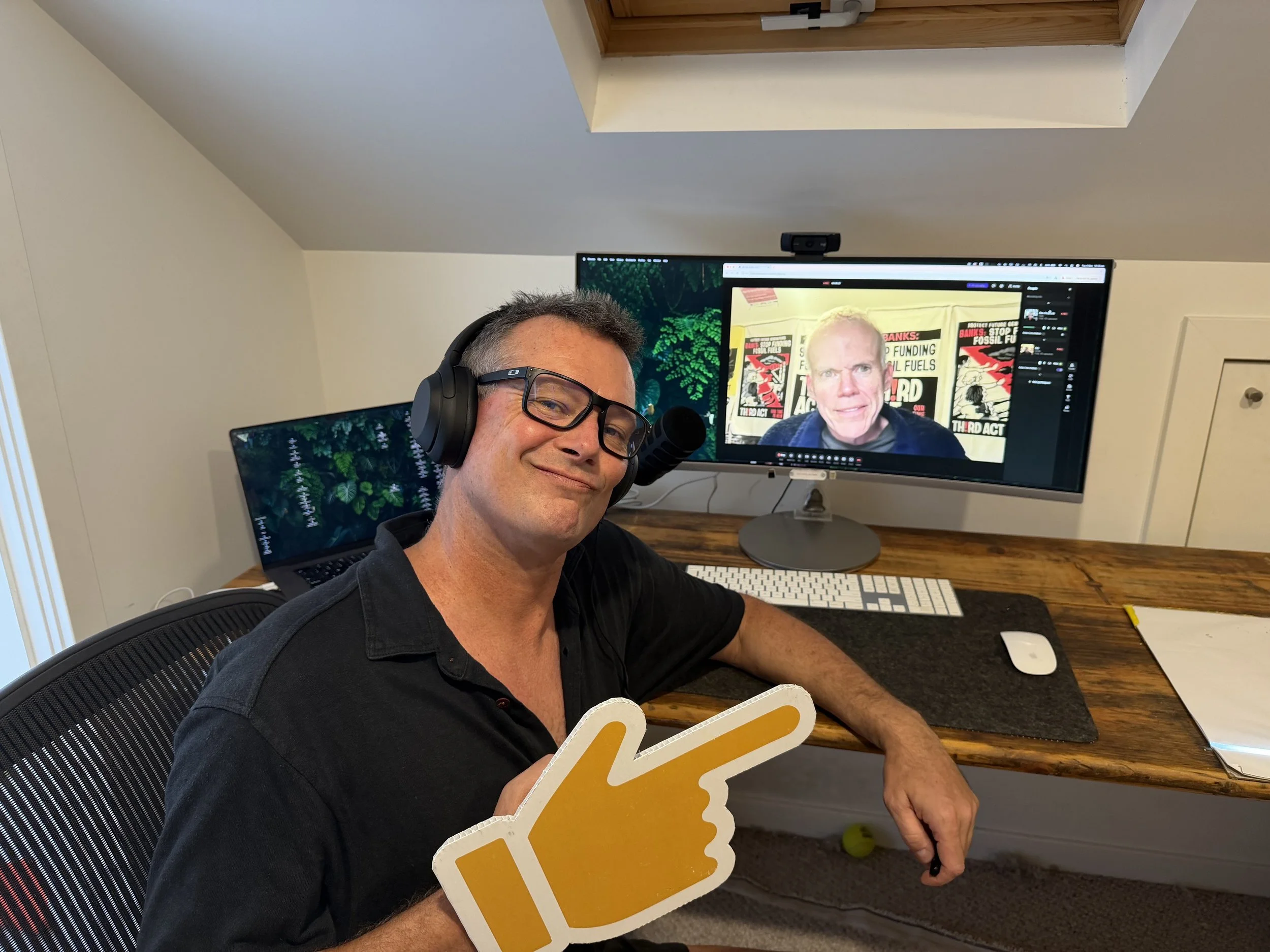
Recording online from Vermont, USA.
Full Episode Transcript
Ben: 0:04
I'll do you a couple of warm-up questions already. Pineapple and pizza, yes or no? No. Favorite sport?
Bill: 0:10
Cross-country skiing.
Ben: 0:12
Best song ever.
Bill: 0:13
This year I'll say Here Comes the Sun, Nina Simone version.
Ben: 0:17
Oh, beautiful. Can you sing it for me?
Bill: 0:19
No, I can't.
Ben: 0:21
No one's sung for me yet. So here we go. You've read the news stories, you've seen the disappearing beaches and devastating floods, possibly even breathed in the thick blankets of smoke. Climate change is real, here, and the most urgent issue on our planet right now, probably ever. Someone needs to do something about it. And fortunately, one man has put his hand up in a big way, Bill McKibben. As co-founder of 350.org, he has led the organization of over 5,000 demonstrations in 181 countries, all on the same day. It was described by CNN as the most widespread ever global day of political action. Not satisfied with that, he helped curate a planet-scale art project with over 20 works around the world, many visible from space. Then spearheaded the movement to encourage institutions to divest from fossil fuel companies. He's been awarded the Gandhi Peace Award, named one of the hundred most important global thinkers, described as probably the USA's leading environmentalist and the world's best green journalist, as well as touted as a possible future Secretary of Energy. Oh yes, and between all that, he's written a dozen books on climate and the environment, and is founder of the Third Act, a movement empowering elders to protect the climate and strengthen democracy. In my eyes, he's the godfather of the modern climate movement. So it's an absolute pleasure to have him here with us today. Welcome, Bill.
Bill: 1:34
Well, Ben, very, very good to be with you.
Ben: 1:36
So look, I've heard you describe yourself as a professional bummer out of people, which is not about you, of course, it's about the topic. You talk about climate change. There's not a lot of good news about. But your latest book, Here Comes the Sun, and the accompanying movement, Sundays, is almost all about good news. What has got you suddenly so optimistic?
Bill: 1:54
Well, optimistic is an overstatement, I guess. Look, there's a lot of very bad things happening on our planet. I I wrote the first book about climate change back in the 1980s, a book with the cheerful title The End of Nature. And the things that we said would happen then are now happening. And they're all bad. And the planet is hotter than it's ever been, and it's causing fire and flood and every other calamity. And in too much of the world, we've begun to lapse into a kind of authoritarian or semi-fascist torpor. In the middle of all those big bad things, there is one big good thing happening. And it's big enough and good enough that it raises the chance that we can take a bite out of both the climate crisis and the authoritarianism crisis at the same time. And that is, as you say, this very rapid rise of what we used to call alternative energy, but we shouldn't call it that anymore because it's now the straightforward common sense path. 90% or more of new electric generation on planet Earth last year came from the sun and wind. So it's not in any way an alternative. It's what we've got. And it's the first scalable tool that we've had to keep our climate livable. The fact that we've now passed some invisible line where it's cheaper to generate energy from the sun and the wind than it is from burning coal and gas and oil. That's a potentially revolutionary moment for human beings. We just have to seize it fast before we irrevocably break the climate system, which we're pretty damn near doing.
Ben: 3:33
It sounds like we are fortunately actually embracing it quite quickly. I read a statistic that said last year China put on almost as much capacity as the rest of the world kind of ever has in renewables. And you've got some other ones who said three gigawatt a day they're putting on currently, which which probably doesn't mean much to most people. But how how big is that?
Bill: 3:53
Gigawatts are big coal-fired power plants and gigawatts worth of power. Now, the solar panel doesn't do it around the clock, so the capacity factor is a little different, but that's the scale of what we're talking about. And yeah, I mean, the Chinese are putting up about two-thirds of the world's renewable energy, which should give you some sense because you know that in Australia they're putting up quite a bit, you know, and in California and Texas quite a bit, but it's dwarfed by what the Chinese are doing. They've made a full-on all-in bet at the global poker table that this is the technological driver of the future, that it will land them in the economic driver's seat and probably give them a kind of global political primacy as it plays out. The U.S. has made the very stupid counterbet that we'd be better off with coal and gas and oil, maybe with a little artificial intelligence thrown in. And in nine months, as a result, primacy on this planet, I think, has passed from America to China pretty decisively.
Ben: 4:56
Yeah, I've always noted that the British Empire was the biggest empire ever that the world's ever seen. It was essentially driven off the fact that that coal-fired power was invented there. Therefore, you had industrialisation, therefore, the ability to create ships, et cetera, et cetera. And then you look at the rise of obviously the riches of the Middle East. Essentially, the history of the world is whoever controls the power source, the energy source, controls the world. So given how fast electrification is happening, and we're seeing like, I think there's 10 new brands of EVs out of China arriving in Australia at the moment. Why would the whole world not just make a race to this? Why would anybody hold back?
Bill: 5:33
I mean, the whole world really is, or at least the 80% of humans live on countries that are net importers of fossil fuel. So for them, this is all upside because they have to spend huge amounts of precious foreign currency buying the next tanker load full of American LNG or Australian coal. And now they don't have to. They can buy a shipload full of Chinese solar panels, and over their lifetime, they'll produce a hundred times as much energy as a shipload of Australian coal. They get to depend Malaysia and Indonesia and Vietnam, and they get to depend on the sun instead of on erratic foreign suppliers. And in the process, they get all kinds of other benefits like clean air. Nine million people a year die on this planet from breathing the combustion byproducts of fossil fuel. That's one death in five. Concentrated in Asia. They don't need that. Um, not anymore. The sun and the wind and batteries will do the job and do it cheap. And then, as you're you're right, there's all the kind of technologies that follow on from that. The EV, China's now the dominant automotive player on the planet. The heat pump, the induction cooktop. My favorite of all, the virtually magic technology that we're calling the e-bike. Bicycle was an elegant technology already, but now we've invented a bicycle with no hills. And that's about as good as it's going to get, I think.
Ben: 7:04
You should see the um adoption of those here. They're absolutely everywhere. People love them. Because also, I think this is a part of electrification. It's quite fun.
Bill: 7:12
Yeah.
Ben: 7:12
Like these new creations are fun.
Bill: 7:14
All this stuff's better than the stuff it replaces. I've driven an EV for many years now. I would no more go back to a gas-powered car than I can't even imagine. It doesn't break because there's almost no moving parts. If you want to go fast, it goes way faster than anything you've ever driven before. It's quiet. The news from Beijing and Shanghai in the last six months or a year is that the cities have become noticeably quieter because so much of the traffic now is EV. Not to mention, noticeably cleaner. The list of the dirtiest cities on the planet no longer has any Chinese cities on it.
Ben: 7:52
That's incredible, isn't it? Given that 10 years ago it was probably quite the opposite. The shift is so fast, they say, you know, things change slowly then until they don't. And is it true? The amazing thing about all this is you can power your planet by covering about 1% of it in solar.
Bill: 8:06
One and a half, two percent in solar panels and wind turbines, yeah. So probably not much more than we're using for coal and oil and gas now. Certainly Australia is using a lot of its territory. I've been to Australia. I've been up in the, you know, those valleys where they're just tearing them apart for the coal underneath. And the land that we use for sun and wind, we use mostly quite benignly. When you put up wind turbines, you leave 95% of the land intact to do with what you want in between them. Graze cattle, grow crops. A solar farm, about half the land remains for this entirely new field of human endeavor that we're calling agrovoltaics. We really need a better name. It just means growing stuff in the aisles between the solar panels. The solar panels, the solar farm, produces a lot of electrons, but it also produces shade, which turns out to be a useful commodity on an overheated planet.
Ben: 9:03
We've seen that here. You've seen the photos of um cattle and sheep hiding beneath them when it gets hot.
Bill: 9:09
In France, the wine growers are discovering that their uh yields for some grapes are up 60% when they're growing them in and around solar panels, just because they've got shade and the moisture retention that comes with it.
Ben: 9:22
I mean, people, you've been working in this field for geezer probably 50 years, and I'm up to about 20. And I find this so challenging because you see over and over how the sustainable version or the more sustainable version is so much better. You know, so much better. I read a report this morning saying that the companies with net zero targets, et cetera, are finding it a great driver of business. And for various reasons, it's it's a really positive thing. Yet there is so much pushback against this stuff, you know, whether it be political or whether in Australia we're seeing farmers literally ostracized by the communities for putting in panels or wind farms by other farmers. Why when everything is better?
Bill: 9:59
We've had a 35-year campaign against clean energy from the fossil fuel industry. The only people for whom this is bad news are people who own coal mines and oil wells. Sadly, in my political system, and to some degree in Australia's, being very rich from your cash flow from oil or coal gives you the power to game our political systems and our media systems. Look, you guys know a lot about of all the Australian exports to the rest of the world, the most dangerous one was Rupert Murdoch, you know. And that's damaged the entire English-speaking world over and over and over again with just the kind of poisonous information you're describing. But you know exactly what's going on because you can look at your collection of fossil fuel billionaires. What can I tell you? I mean, these are not the people that you want running the government or having big influence on it because their interests are so tied up in the status quo that they cannot allow the future to happen.
Ben: 11:02
I guess for them, they've had their chance to shift to renewables, I guess, and they didn't take it. Trevor Burrus, Jr.
Bill: 11:08
You know, the CEO of Exxon said last year that they were they were never going to invest in renewables because, quote, it doesn't offer above average returns for our investors, which is true. You can't get, you can get there'll be plenty of solar millionaires and billionaires, there already are, but you can't get Rockefeller rich because once the solar panel's up, the sun delivers the energy for free. If you're Clive Palmer, something that's the stupidest business model of all time, you know, because you got rich by making people keep paying you over and over and over again for the next load of coal or gas or oil. So not good.
Ben: 11:46
I mean, there's a there was an interesting study I read once that said that 100 companies are responsible for 71% of all emissions that have ever been made. I would take a punt that those within that hundred are the vested interests that are fighting for against solar now.
Bill: 12:01
Well, absolutely. I mean, that's that's what this fight's about. And it has been really from the beginning. I I told you I wrote the first book about climate change back in the 1980s. We now know from good investigative reporting that the big fossil fuel players were busy investigating climate change back in the 1980s, too. And they knew all about it. Their scientists told them the same thing that scientists at NASA and, you know, at the Australian research institutes and things were saying. And they were believed. Exxon started building all their drilling rigs higher to compensate for the rise in sea level they knew was coming. Okay. They just didn't tell the rest of us. This whole industry mounted this endless long campaign of disinformation. And by the end of it, the president of the United States is announcing that climate change is a hoax manufactured by the Chinese. I mean, if you were sitting on a bus next to someone who was muttering that, you would get up and change seats, you know. But now your national party is insisting that, you know, they want to. I mean, I remember when what's his name was wandering around uh Canberra with uh, you know, a lump of coal and passing it around to all fellow legislators as if he'd found, you know, a piece of the true cross or something. This stuff's crazy at this point because it's no longer theoretical. We can measure the increase in temperature, we can measure the increase in sea level, we can measure the increase in wind speed that comes at these great hurricanes, we can measure the increase in rainfall that comes with the devastating floods. We've watched huge sections of Australia and America and Canada and Europe, South America burn to the ground. I mean, it's just craziness at this point.
Ben: 13:47
What you speak of strikes me as one of the greatest challenges. You know, you speak of knowing of climate change since the 1980s. I've gone and found clippings from early 1900s and even before that. I think the oldest known story is like 1876.
Bill: 14:00
We understood the physics of it, but it wasn't until the late 1980s and Jim Hansen that this became a public that we understood that we were on the threshold of something dangerous. So it's been, we're closing in on 40 years now of the climate story.
Ben: 14:16
I mean, I think anyone who works in sustainability finds this frustrating that like we know the science and also we have a lot of the solutions. It's not like, wow, this is a big impossible problem we can't solve. It's it really comes down to hearts and minds and willpower. Yet time and time again, we seem to be unable to, or people who are calling for this seem to be unable to change those hearts and minds. Do you think there's just a fundamental challenge in creating change?
Bill: 14:42
No, I think we're making good progress. It's just that it's against the constant backdrop of the fossil fuel industry buying politicians and buying newspapers. And that makes it more difficult. But no, you know, look, Australia's, I mean, remarkable things are happening. South Australia is now more or less running on renewable energy. We're closing in on 40% of Australians with solar panels on their roofs. This is remarkable. And there are people doing everything they can to speed it up. You know, Saul Griffiths has become one of the world's great, the kind of Johnny Appleseed of solar panels and other Australians playing remarkable roles in this work around the world. I mean, the question is not, are we going to do this? 40 years from now, we're going to run the world on sun and wind because it's cheap. The question is, will it take us 40 years? Because if it does, then the planet we run on sun and wind will be a broken planet. Our job is to speed it up, to make it happen faster. And that means a lot of work around hearts and minds. We just came through this Sun Day thing that you were referring to. We had about 500 events across the United States. I think we'll do it globally next year at the autumnal solstice there at the equinox in the fall, northern hemisphere fall year spring. And it'll be, I hope it'll be a big and beautiful day. And hopefully it'll be a lead-in to what we're thinking is likely to be the global climate talks, which should be in Australia next year. That's the current thinking, anyway. And if they are, then I think that'll be the solar summit. That's what the world will be focused on because there's so much happening in Australia. Talk me through Sunday.
Ben: 16:26
Talk me through Sunday. What what what happens? How does it work?
Bill: 16:28
We had a you can go to Sunday.earth and see the website that we set up. And we just asked people all across the country to do something that day that would mark this surge in renewable power and help convince people to speed it up. We had every kind of event all across the country, people putting up habitat for humanity houses with solar panels on the roof, big e-bike parades, every kind of concert powered by batteries and solar panels, you know, on and on and on across the country. It was a beautiful day with a lot of groups coming together. We kind of led the work at third act, but lots and lots and lots of people joined in. And of course, at some level, it was a political rebuff to the nonsense that's going on in Washington right now.
Ben: 17:15
It's so interesting, isn't it? It's basically a celebration of the sun. And you go, wow, that's that's been going on in tribes for thousands of years, right?
Bill: 17:23
Yeah, that's that's not an insignificant point. One of the reasons that this work is doable, I think, is that humans have a deep connection to the sun. I obviously stole the title of this new book of mine from George Harrison. But if you go to Spotify, it turns out that twice as many people a day listen to Here Comes the Sun as any other song in the Beatles vast catalog. That's because it's an optimistic tune in a dark time, but it's also because people love the sun. There are 500 great songs about the sun. Every singer with their salt has produced one. We put together a huge list, playlist for Sunday, a lot longer list than the great songs about fracking that you've come across. Human beings literally get depressed if they don't get enough sun. We call it seasonal affective disorder. We think this goes back a long way. We don't know exactly what prehistoric people thought about anything because they were prehistoric, but they left behind a lot of piles of stones, and almost all of them seem to point to the solstice or the equinox, you know. Every mythology that starts out on this planet, one of its first jobs is to explain how this thing rises over here, sets over there, and gets back over here by the next day. So there's a lot of great stories about turtles carrying the sun or emus swallowing it, vomiting it out the next day, and you know, on and on and on. Energy from heaven, not from hell, is a relatively easy concept to sell. At this point, I think it's harder for the oil industry to sell the idea that we should just keep pouring smoke into the atmosphere in order to keep their profits high.
Ben: 19:05
So beautiful how you speak it. It's true. Everybody worships the sun. It's just part of who we are. I mean, it gives it's the giver of all life, isn't it? And in a way, when we dig up fossil fuels, all we're doing is you know digging up what's the sun has created some other time and going to so much effort to do it when it's just pouring out of the sky.
Bill: 19:23
Exactly right. We waste extraordinary amounts of energy that pour down on us every day. No place more than Australia. The sun and the wind are extraordinary. And the only thing that you can't do with them is hoard them, hold them in reserve, sell them to someone in quite the same way you can coal and oil and gas. And hence for deeply greedy people who have devoted their lives to digging stuff up and hoarding it from other people, this is bad news. For the rest of us, good news.
Ben: 19:56
What's the Gandhi quote? Something like the earth provides everything for everyone's need, but not for their greed. I'd love to go back through a few of your creations. You've mentioned Third Act, which, as I say, which is a beautiful thing. You know, people, this is often there's this little fake stoution media of almost like millennials, Gen Z versus, you know, baby boomers. And I always remind students that, like, hey, baby boomers created the environmental movements. These are the people they may not have won the day along the way always, but they created it. And you're giving this generation a chance to kind of come back.
Bill: 20:29
That's right. Those of us in our 60s and 70s and 80s now, in our first act, were around for those moments of extraordinary cultural, political, social transformation in the 1960s and 1970s. So when we started taking women seriously in public life in my country, the rise of the civil rights movement, the first Earth Day in 1970, which really was the touch paper for global environmentalism. And within a few years, we had the Clean Air Act and the Clean Water Act and all the other things that became the templates for environmental regulation across the planet. The things that Donald Trump and his crew are now doing their damnedest to undermine and unfortunately succeeding all too well. But the third act is about finding that generation and getting them back to work. And it's been very successful. We have about 100,000 people across the country now. They're doing beautiful work, very, very good at lobbying the state and local level because in our country, you know, voting is voluntary, but old people vote and politicians know it. So we carry some weight when we uh show up. So Third Act's been very gratifying, and we've really enjoyed it. It builds on work that I spent my life doing with young people. Uh you mentioned 350.org, which I started 20 years ago with seven undergraduates at the college where I teach here in Vermont. And you're right, within a year or two years, we'd organized uh that Day of Action that was a kind of coming out party for the global climate movement in 2009. 5,100 demonstrations in 181 countries. I think 350God.org's gone on to organize about 20,000 rallies in every country but North Korea. And we've fought some huge battles against pipelines and things. We took much of our early inspiration from wonderful work in Australia, especially the Australia Youth Climate Coalition, who were doing just remarkable things. And on that big day of first big day of action in uh 2009, of course, the very first picture that came across the wires, because it was morning in Sydney, was a huge crowd of people from the AYCC on the steps of the Sydney Opera House. And that really kicked things off, got them going all over the world. Now we have great colleagues and comrades across the Pacific, the Pacific climate warriors in all those countries, Tuvalu, Vanuatu, the Marshalls, the Solomons, all the places that are some level fighting for their lives. But their slogan is, we're not drowning, we're fighting. And maybe the greatest moment of that fight, or one of them, came some years ago when each of those islands sent a uh built a canoe, war canoe, and sent them off to Newcastle there, where they blockaded the big oar carriers for a day and kept them in port. Truly beautiful and symbolic show for what we need to be doing on this planet.
Ben: 23:38
What's beautiful about this when you describe it, whether it's people on the opera house or it's people on Sunday doing the e-bike kind of rallies or people organizing in canoes is they've kind of chosen what they want to do. You've set the broader agenda of do something. It's organized, but it's also free form for people to express themselves. But that's an enormous undertaking to get like 5,000 different groups to do that. How you've done it with 350.org multiple times. You've done it with Sunday, you've done it with Third Act. How do you get so many people doing something?
Bill: 24:10
So in this country, we have a thing we call potluck supper. Is that a phrase that makes sense in the world?
Ben: 24:17
I I can translate it. It basically means bring to dinner whatever you feel like it, isn't it?
Bill: 24:22
Right. So like I'm a Methodist. So Methodists are famous for potluck suppers. Everybody come to church and they bring a dish. You know, you bring a casserole, you bring some beans, you bring some whatever you got, and everybody lay them out at the table and everybody eats. That's what this kind of organizing is like. It's not like some big fancy organization, 350.org nor third act, nor anything else, had a lot of money, or, you know, it was really, we were just saying, here's the date and the time, and you figure out what to bring. And people all around the planet have responded. We've never had the slightest trouble with people misusing the occasion or deciding to get violent or, you know, anything else. People have always managed to figure out what works where they are. Because of course, people in Fiji are better at telling other Fijians why climate change matters or than I am, because look at me, I've spent about as much time under the Pacific Sun as not much. So that's how we organize, and it works well.
Ben: 25:23
So what do you identify all these sort of groups from around the world and and and go out to them?
Bill: 25:28
The internet is a curse in many ways, but one thing it has been good at is lowering the barriers to doing this kind of work. We're able to communicate relatively easily. And then when people do things in the real world, we're able to take those images and share them around the world so that everybody can understand that there they are in their small gathering of people at Alice Springs or wherever they are. That makes them also part of a big, broad global movement. And that's very important and very heartening to everybody.
Ben: 26:04
So obviously you speak of the use of the internet and that it's not it's not like older people, people in the third act don't use the internet, but obviously, probably less so than you know people who've grown up with the phone, but truthfully, uh, it turns out that it's people my age who invented computers and figured out how to program them.
Bill: 26:22
You'll recall back when we had Y2K at the year 2000. What were they doing? They were calling up old programmers to come rescue them. So most old people are pretty good at, you know, if nothing else, during the pandemic, you had to learn to use Zoom or you couldn't talk to your grandkids. So we're not quite as feeble as all that.
Ben: 26:44
It's uh interesting how the world rolls, isn't it? Things like that. It's just that that did create the adoption of Zoom. I mean, video conferencing was around for almost 10 years before that, and no one picked one up. Yeah, no one used it. Um 350 Dog, uh, you one of the seminal things you did there was and always stuck with me. I've told this to so many people, the Rolling Stone article you wrote, which I believe uh I don't know if it still is, but at one point was the second most read ever in Rolling Stone. And I believe you've told the story that it was an article with Justin Bieber on the cover, and and your article got 10 times more likes on Instagram than than Justin Bieber did, which is pretty impressive. What I really thought was so beautiful is it you defined climate change in three numbers that make it so easy to understand. Could you tell us the story now?
Bill: 27:28
Sure. I mean, just so as a basic reminder to people that this is a math problem at some level. If we're going to hold the temperature, rise in temperature below, let's say, two degrees Celsius, we know about how much carbon we can put in the atmosphere and still have some hope of not breaking the climate system past that point. And truthfully, it's not much left. We also know the third number is how much carbon the fossil fuel industry has in their reserves that they're planning to toss into the air, that their business models call for, that they've told their bankers they're going to produce. And that number's five times higher than the number scientists say we can safely put in the air. So if we allow the fossil fuel industry to just carry out their business plan, the end of this story is written. You know, there's no drama about how it comes out. We end up in uh, if not hell, then someplace of a quite similar temperature. So our job is to disrupt that process at some level, to prevent them from doing that. Some of that's doing things like stopping pipeline construction and you know, new coal mines in the Galley Valley and on and on and on. But now the main, I think, way to do it, the single most dangerous thing to the fossil fuel industry is the rapid spread of a cheaper, cleaner alternative. The force of economic gravity for the first 35 years of the climate crisis worked in their favor. Fossil fuel was relatively cheap, renewable energy relatively expensive. But having crossed the line where that flips, now economic gravity works in our favor, and they have to scramble politically to try and hold off the inevitable. They'll do their best to hold it off as long as they can, and they may, in the process, hold it off long enough that the planet breaks. When I say the planet breaks, I'm not being glib here. We're beginning to see the flickering and faltering of the biggest systems on this planet. The jet stream draws its power from the differential in temperature between the equator and the poles. As the poles warm, the jet stream begins to go wonky. The Gulf Stream, the great currents of the Atlantic, the biggest heat distribution engine on Earth. As fresh water is pouring off the Greenland and the Arctic, it's changing the salinity and hence the density. Of those waters. And now we're seeing real and unmistakable signs of the slowdown of those great currents. The Amazon at its edges beginning to, as the scientists say, savannify, turn into savannah, and the miraculous system for water transport across South America breaking down. From what we can tell, the monsoon regime in Asia is beginning to shift in dangerous ways. None of this is good news. And we have very limited time to deal with it if we have time at all. That's why it feels all so urgent to me that we get going, that we get cracking here.
Ben: 30:44
Do humans survive on I believe six degrees is the Yeah.
Bill: 30:48
I mean, we're not we're not gonna, I don't think we're gonna raise temperature six degrees. And at any rate, yes, some humans will survive. We're an adaptable species. And some crows will probably survive, and some rats will probably survive, and maybe the odd coyote, and on and on. But the last five times that we've dramatically raised the CO2 level on the planet over the last couple of billion years, we've had enormous extinction crises. At the end of the Permian, we lost more than 90% of the species on the planet. We're raising the CO2 level much faster now than we did at the end permium. So we're just literally playing with fire at this point.
Ben: 31:29
Everything you say, I think the majority of people get it. You know, as you say, especially in Australia, we've seen it. You've breathed it, you know, you've felt it. People understand it. And but I think one of the great challenges with all this is sort of the short-term versus the long term. Yeah. We all know that long term this is necessary, but short term, especially when you end up with cost of living crisis, these things, people's perspective shifts very shortly.
Bill: 31:50
At this point, it's all short-term.
Ben: 31:52
Yeah, that's interesting.
Bill: 31:53
I mean, it's not like we're talking what's going to happen to your kids. I mean, we're talking about stuff that's already started to happen. I mean, hell, what was when was the horrible fires in Melbourne? You know, that's like 10 years ago now, right?
Ben: 32:06
We had them in Sydney probably less than that. And everybody's just waiting for the next ones. Yeah. It's like everyone gets it's coming again.
Bill: 32:12
So that's short term. You know, when you talk about the affordability crisis, I don't know what's happening in Australia. In the US, our insurance industry is beginning to break because they can't figure out how to price risk at all. You know, now that things catch on fire all the time and we have floods like we've never seen before, whatever, people's insurance premiums are going through the roof. And in lots of places, the value of their houses is starting to go down because you can't get insurance and hence you can't get a mortgage and, you know, on and on and on. So, and even if all anybody cared about was economics, you know, this is by far the most expensive thing that humans have ever even contemplated doing. Hurricane Melissa hit last week in Jamaica with the highest wind speeds we've ever recorded on this planet. The as the hurricane came ashore, the airplanes dropping sensors through the winds at about 600 feet found winds of about 252 miles per hour. The damage in Jamaica, the lowest estimate from the insurance industry now is that it's equivalent to 30% of that country's GDP. I don't know what Australia's GDP is, but in America, that would be the equivalent of a hurricane doing $9 trillion worth of damage. Okay. You know, Jamaica will never be the same again. It doesn't have the money to dig out of the hole that it's now fallen into. On and on and on. So the idea that that realistic people somehow want to put off for a while dealing with this until I don't know what, things get better or something is just silliness.
Ben: 33:53
Yeah, we we um just the story in Australia, it's probably most resonant. We had a whole town called Lismore taken out basically by a flood. And and and literally the government had to buy back some houses because people got caught in that situation where if they rebuilt their house, they couldn't insure it. If they didn't rebuild it, they didn't have somewhere to live. And of course you can't sell it because no one wants to buy it. It it creates this and so the government stepped in and bought it, but you go, well, that's a short-term solution. That can only happen occasionally, can't we?
Bill: 34:19
And if it's one little town, well, okay, I guess, but that's not what we're talking about anymore. I mean, in America, we lost huge sections of the second largest city in the country, Los Angeles, to wildfire in January. So much has happened since January that we hardly remember this. True. It's a big effing deal, you know.
Ben: 34:42
I I want to go back to the hope at some point. But um, just before I do, uh I'm interested in bringing you know the concept of bringing people along, one of the things you are just incredibly good at is bringing people along. And and of course, that means getting beyond people who are ready to be brought along. You know, I I saw Greenpeace research once saying that people in coal mining communities in Australia, they aren't really in love with coal. They don't love it. It's a pretty dirty job. They know it's not the future, so they know it's terminal, but they've then seen situations where like mining companies have just moved out and left them defend themselves and the whole community's collapsed. So, how do you bring that, those people on?
Bill: 35:17
In this country, anyway, every piece of legislation that we've tried to pass about climate has had lots of money in it for what we call just transition for just that purpose, to help communities that are dependent on fossil fuel extraction train people to do something else if people are too old to be trained to do something else to provide them with the pension so that they don't have to starve. Because it's not their fault. They spent their life doing a useful thing at the time, which was giving us the energy we needed. At least in America, what's happened is the fossil fuel industry and their Republican allies have blocked all these plans because they know that, for their point of view, it's much better to hold these people as hostages, in essence. And so that's what's happened. And it's a sad story. Joe Biden was the last example of this. He passed this inflation reduction act with lots and lots and lots of money aimed at directly these kinds of communities to help them transition. Turns out that if you're a coal miner, you have most of the skills that you need to do things like put up solar panels. You're good at using equipment, you're often good at using, if you're an underground mine, you know a lot about carpentry because you're keeping the, you know, using timber to keep the mine intact, on and on and on. With some retraining, everything is possible. But of course, within six months, the Republicans had gutted this. And now we're back where we were before. America is uh a cautionary tale here. If you keep listening to the kind of people that at some level you know you shouldn't listen to, eventually you're gonna end up with a Donald Trump of your own. And it's gonna be, trust me, crazily painful.
Ben: 37:02
Uh it's crazily painful sometimes watching from here. Um have you seen this, an example of this just transition work well? Is there a town somewhere in the world where there's lots of places?
Bill: 37:13
I did a great, I did a fun story once where I talked to a lot of people in the Dakotas, the North Dakota's big oil fracking, boom and bust state. They were at the community college out there retraining oil field workers to be wind turbine technicians. Much better job. There's nothing boom or bust about wind turbines. They're gonna be turning for decades, and they need maintenance. You know, they need guys who know how to get up there and lubricate gearboxes and on and on and on. Truthfully, the only thing that was challenging to train people on was how not to be worried about the height. So that's what they were working a lot on, climbing people up ladders and getting them gradually accustomed to this. And eventually it worked great. And these guys were like, yeah, you know what? This is a lot better job than the quite dangerous job I was doing in the oil field before. This is a job that will allow me to, you know, not be moving around the country all the time in a kind of boom or bust mode. This is one that I can retire on and raise my kids on. So yeah, there's lots of examples like that.
Ben: 38:21
I see that time and time again. You know, anyone who buys an EV goes, I'd never go back. Anyone who goes to sell the job from coal work goes, I'd never go back. But yet it's so hard to sell people on a positive future.
Bill: 38:32
There's a big status quo bias in everything, you know. We know we're used to what we have, so it's a little scary to change. But, you know, I mean, come on. On the list of big changes that humans have had to make, going from an internal combustion engine car to an EV, I mean, it's not even like going from a horse to a car, you know, it's pretty easy. The whole thing works the same way. You, you know, turn the key, you depress your ankle a fraction of a degree, the car moves away. The only hard part is for you know, remembering that you don't have to go to the gas station anymore. The gas station is just a place where you go buy Diet Coke. That's it.
Ben: 39:13
No more dinosaur juice. So you've started so many things. And and look, the hope of this podcast, apart from hearing great wisdom from great people, is to actually inspire more people to have a go and do their own thing, you know, because fundamentally, if you look at this at climate change, we need pretty much everyone, well, more people, possibly everyone, doing more things more often and succeeding at them. Yeah. You know, if someone's sitting there going, wow, I want to do something, but they don't know what to do, you know, they could start a company, a movement, maybe a podcast. What does the world need?
Bill: 39:47
Look, at least in America and Australia, there's a great bias towards individual action. So that's the first question we all, you know, what should I do? What should I put on my roof? What should I, you know, whatever. Good question. So you don't have to start things like 350.org or something. They already exist. You've got to go just find other people where you are who are working on this and join together with them. And that's not hard. And in fact, it's fun too. It's a good way to be with other people in an increasingly alienated and isolated world. So just figure out who the people are that are doing interesting work in your community, in your territory, in your country. And some of them will be politicians, you know, find political parties that need that are none of which are going to be perfect. Demanding perfection at this point is a little much, but it's pretty easy to tell which are the ones that are trying to make things better and which are the ones that are just trying to keep things the same for their patrons, you know.
Ben: 40:49
And does that count for where you work as well? I mean, what do you look like? If you're a young person coming into the workforce, what would you look for?
Bill: 40:56
Look, you can work on climate change. It's such a big problem in almost any place. And I think I tell kids it's important to figure out work that doesn't take so much time that you don't have time left to be a citizen, you know. It's quite possible in this country anyway to go to if you're an ambitious college kid, your first job at a law firm and they want you to work 125 hours a week, you know, and you have no time to do anything. So stay away from that if you can. I'll tell you the thing I tell young people, increasingly in this country, is who say, I want a job that will help the world and that will support me. Even though I teach at a college and so on, I increasingly tell people, if you have any skill with your hands, the thing you want to do is be an electrician. In America, we're going to need a million or two million more electricians in the next decade to get this job done. No electricians that I know of are hurting for work at all. It's a well-paid job that's now doing one of the most important tasks on the planet, electrifying the earth so that we don't have to destroy it. So that's the closest thing to straight-on advice I've got for anyone.
Ben: 42:04
I can't see that being um taken out by AI anytime soon either. That's another good point. Yes. And it's quite clean, too, of all the trade jobs, electrician, you know, plumbing less though.
Bill: 42:15
Well, I mean, we need some HVAC guys and some plumbers and stuff, all that too, you know. It's the built environment really matters. And this transition is going to be enormous and exciting and already is, you know. In Australia, you get to look at it close up because there's few places in the world that are where at least at the residential level, we're seeing truly enormous transition. It's very cool. I think we're the world later in it, actually, aren't we? The Chinese are um doing the biggest job at the kind of utility scale. But yeah, I think on tops of homes, Aussies are doing their part. It's good to see. Now we've got this balcony solar stuff, you know, for apartment dwellers who don't have a roof. And you just hang a panel off the railing of your balcony and stick a plug into the wall, and often you're getting 20% of the energy that you that you need to run your house just from that. So this stuff is not hard. In fact, if you think about it, it's endlessly easier. Think about what you have to do to get gas to run a car on gas. At this point, you have to be able to drill for oil a couple of miles below the ocean. You've got to somehow get it back on land, run it through a refinery, which may be the most complicated piece of machinery humans have ever built, get it somehow out to the gas station, put it in a car engine with a couple of thousand moving parts where you can endlessly spark a tiny fire to drive a piston in a cylinder, and all of that produces only about 20% of the energy goes to actually move the car. The rest is just waste heat that you have to expel through the exhaust pipe. Compared with, I have solar panels on my roof, and I run a cord into the engine of my car, which has 20 moving parts and takes 80% of the energy it gets and uses, converts it to forward motion. The simplicity of these systems is staggering, you know, and the complexity of the thing that we take as normal is staggering. So we're in the process of destroying the planet, but we actually could imagine leaving the planet in better shape than it is now. Well, try to imagine what the geopolitics of our planet would have looked like for the last hundred years if coal and gas and oil had been of trivial value in that period. Think how many wars we would not have needed to fight, how many coups and assassination attempts and things we wouldn't have needed. You could fight a war over sunshine, but it would be difficult to figure out exactly, you know, how to make it work, I think.
Ben: 44:46
I think I've seen it happen at Bondi Beach in a really hot summer's day occasionally. It's so simple when you put it like that. And you know, and you mentioned the geopolitics. I mean, it is it's almost the you know, if nobody controls the power, if anybody controls the energy, then it does make countries more equal. And it it does stop somebody having leverage over everybody else, which we see over and over again. You said it. Yeah, so it's a pathway to peace as well, really. There you go. Before we finish, I'd just love to know a little bit about you. You know, I I know a lot of people work in this movement, myself included, you know, it's almost like you see the wave come in and suddenly everybody's interested. And, you know, things like inconvenient truth create this huge conversation, and it's almost like the wave goes out, and then and and then the wave comes in, and and you think this time, you know, about 2018, every company was falling over itself to have targets and goals, and we saw products about this and and that, and then suddenly it all goes out again. You know, you've you've been doing this at least twice as long as me. So you've seen more waves than me. How do you personally keep up hope within all that in the down in the ebbs, if you like?
Bill: 45:48
Yeah. Um well, I mean, I've always understood it to be a difficult problem, so that helps. And, you know, I have good people to work with all over the world, volunteers like me on this stuff. I find it endlessly intellectually interesting. I think it's the most thorny intellectual problem humans have ever grappled with. And I spend as much time as I can outdoors. One of the reasons I would like to save the planet is because I enjoy the planet. And so I ski or bike or hike pretty much every day just to be out in the world. That's why I live deep in the woods the way that I do. Because I don't think I'm not sure I'd be able to keep my mood up if I couldn't get out in the world as often as I do.
Ben: 46:32
Appreciation of nature. It's one of the great connections to environmentalism, isn't it? It's actually enjoy nature. It's um I I I try and um take my daughters out and make them, you know, not make them, but get them surfing, get them doing things just for that reason. Absolutely. That's right. Um, what's one thing people are surprised by when they find it out about you?
Bill: 46:50
I'll tell you the truth, people are often surprised to find out that I'm a Christian because their version of environment, you know, what a progressive politics and environmentalists and stuff doesn't always match up with that. But that's one part of my makeup. And since we were instructed to love our neighbors, it seems like it would be a good idea to stop drowning them and you know, starving them and setting them on fire and all the things we're doing at the moment, you know. So I guess that's one thing that surprises people sometimes.
Ben: 47:25
I believe Christianity says respect a planet too, somewhere in there. It's not in the Ten Commandments, but it's in there somewhere.
Bill: 47:37
A job, I'm afraid, that we have so far we have failed at. We have turned up the thermostat pretty dramatically, and that turns out to be a bad idea. So that's why it'd be a good idea to get our act together sooner rather than later.
Ben: 47:51
Sadly, quite a lot of cultures did respect the planet. Well, probably still do. Actually, a lot of people do, to be honest. Yeah. Absolutely. Finally, last questions. Anyone wanting to enter the climate movement now, following your big shoes, three tips for somebody.
Bill: 48:05
I actually really think I only have one, and I I've already told you. I mean, just don't try to do it by yourself. Find others who are working together on this and join them. Join your neighbors, join your neighbours, join your neighbors. Those are my three tips.
Singers: 48:20
Great three tips. Thank you. Um just personally, I just want to thank you for everything you do. You know, it it is whenever you're working in these issues, it can be a struggle. And it and it, you know, you always feel underfunded, undertimed, and and and honestly, I once said to someone working in the environmental movement is like you're losing by 10 goals, can we lose by nine this week and then eight the next week? You know, and and having people like you spend their lives pioneering this stuff and and giving people somebody to look up to and follow and and watch. It just it it's it I can't tell you how much a difference is. I got you, brother.
Bill: 48:56
It's good to have a big, broad movement, and that's what we need from every corner of the earth. So those of us up top here are very glad that those of you down under are doing your part, and uh I'll very much look forward to my next trip to the Antipodes, maybe for the uh global climate conference next year.
Ben: 49:14
Let's hope so. We can talk about how it's all going electric.
